Fifty-Nine Years Later: Was the Six-Day War Really a Miracle?
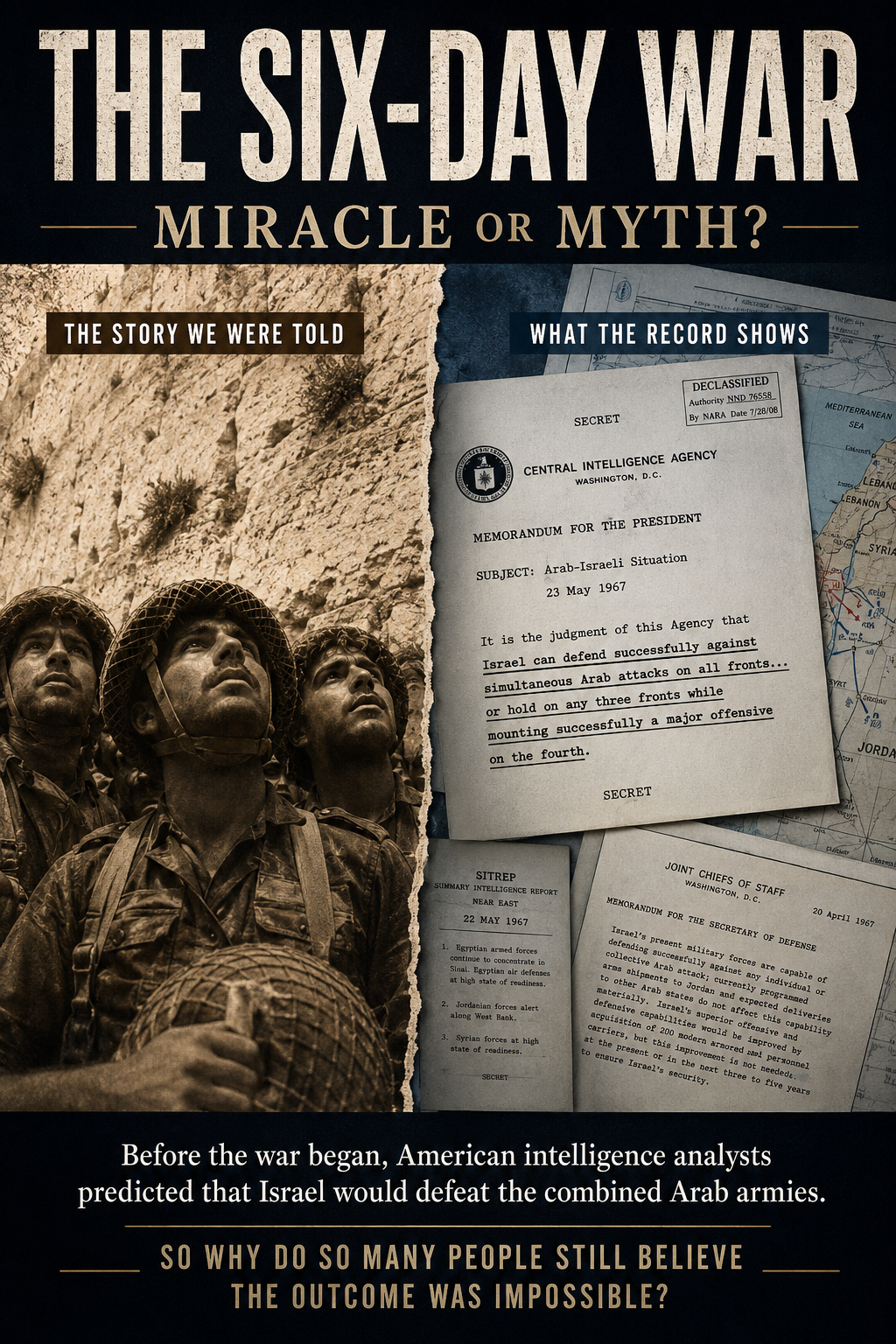
Every year, around the anniversary of the Six-Day War, the same story is repeated.
Israel Celebrates the Anniversary of the Six-Day War
Tiny Israel stood alone against overwhelming Arab armies. The Jewish state faced possible annihilation. Against impossible odds, it achieved one of the most astonishing military victories in modern history.
For many people, this narrative is so familiar that it feels beyond dispute. It has been repeated in documentaries, school curricula, speeches, newspaper articles, synagogue lectures, and social media posts for decades.
But there is a problem.
The military experts who studied the situation before the war did not think Israel was facing impossible odds.
They expected Israel to win.
In fact, before a single shot was fired, American intelligence agencies concluded that Israel could successfully defeat the combined Arab armies. U.S. military and intelligence assessments repeatedly emphasized Israel's qualitative superiority in training, command structure, intelligence gathering, logistics, and air power. President Johnson's advisers were so confident of the outcome that they predicted an Israeli victory even if multiple Arab states entered the war simultaneously.
This does not mean the war was risk-free.
People would die.
Wars are unpredictable.
Mistakes can happen.
But there is a substantial difference between saying a war involves danger and saying a nation faces imminent destruction.
The chapter of history remembered by many today often skips over that distinction.
The conventional narrative portrays Israel as a helpless David confronting an Arab Goliath. Yet historians who later gained access to military records found something quite different. The Arab armies were plagued by poor coordination, weak leadership, inadequate training, political infighting, and ineffective command structures. Israeli forces, meanwhile, possessed superior organization, superior intelligence, superior pilot training, and a unified command system.
The outcome in June 1967 was not the one military professionals had considered impossible. It was the outcome many of them expected.
So why has the war been remembered differently?
The answer may lie not in military history but in national mythology.
Every nation creates founding stories. Americans have Valley Forge. The French have the Storming of the Bastille. Modern Israel has the Six-Day War.
The war became more than a military victory. It became proof of a larger story: that the Jewish people had risen from centuries of weakness and exile to become masters of their own destiny. Once a military victory acquires that symbolic role, questioning the story becomes difficult. The historical details become secondary. The myth becomes more important than the facts.
History should be judged by evidence, not slogans. And when we look at the evidence now available, the picture that emerges is considerably more complicated than the annual commemorations usually suggest.
Fifty-nine years later, perhaps the most interesting question is not how Israel won the war. The military experts answered that question before the war even began.
The more interesting question is why so many people continue to believe that nobody can explain it.

What’s on the Ballot