The Sword as a Value
Sixth in a series on Zionism, Judaism, and why the difference matters. Read the earlier parts here: Part 1 | Part 2 | Part 3 | Part 4 | Part 5
Ask anyone in the world to name one thing about Israel, and there's a fair chance the answer involves the army. The soldier is the state's icon — on its posters, in its films, at the center of its national story. And the story usually comes with an assumed pedigree: this is the ancient Jewish warrior reborn, from Maccabee to modern commando, an unbroken martial line.
But the line is not unbroken. In fact, there is no line. For roughly two thousand years, Jews were famous across Europe for the opposite quality — a people of scholars, merchants, and men of the book, so consistently unwarlike that their enemies made a slur of it. That character was not an accident.
But changing that character was a concerted project, run by particular men with particular teachers, and this article is about who they were.
What the tradition actually taught
The traditional Jewish view of the warrior was not neutral. It was condemnation — and the condemnation is old, written down long before Zionism existed and so impossible to dismiss as anti-Israel politics.
Rabbi Samson Raphael Hirsch, the great German rabbi who died in 1888 — nine years before the First Zionist Congress — explained the Torah's command to blot out the memory of Amalek, the Bible's archetype of evil, as a war against the glorification of violence itself. What threatens mankind's future, Hirsch wrote, is not merely the ancient tribe of Amalek but the honor paid to "heroes of the sword" — because as long as humanity admires its conquerors, each generation will produce new ones. Seeking renown through arms, in his reading, is the enemy of everything God wants from the world. The scholar bent over his books was not Judaism's failure to produce a warrior. He was Judaism's answer to the warrior.
That is the inheritance the Zionist movement received. And it was what the movement set out, in its own words, to destroy.
Blood and fire
The reversal began early. In 1903, the poet Yaakov Cahan published a hymn to the ancient Jewish rebels that gave the movement one of its most durable slogans: "In blood and fire Judah fell; in blood and fire Judah shall rise." Jewish gentleness was recast as shame — cowardice, weakness, the mark of a broken people — and the mockery of the meek Jew became a standard feature of Zionist writing, echoing, sometimes word for word, what the antisemites had been saying all along.
Then came the First World War, and Europe showed the movement what modern militarism looked like. Whole societies mobilized; violence was recast as noble and regenerating; and in Italy a doctrine called Fascism took power that made the militarized nation an object of worship.
Fascism's admirers included, quite openly, one of Zionism's most important founders.
Jabotinsky
Vladimir Jabotinsky — whose movement became today's Likud, the party that has governed Israel for most of the last five decades — believed the military was not a tool but an ideal. Military education, he taught, contains exalted values that nothing else can impart. He announced a new alphabet for Jewish youth: "Young men, learn to shoot!" When a Jewish student group in Vienna proposed dropping its ceremonial trappings, he told them everything could go except the sword, because — his words — "The Torah and the sword were both handed down to us from heaven." Of course, no such teaching exists in Judaism. He was inventing scripture for the new faith.
His youth movement, Betar, absorbed the style of the era's fascism, and the record here is uncomfortable enough that the movement's own rivals said so at the top of their voices. Betar units in Italy trained under Mussolini's regime; at one ceremony at their maritime academy, recorded proudly in a Revisionist publication, the youths hailed Il Duce while a rabbi invoked blessings on him. A senior Revisionist official told a Jewish magazine in 1936 that he personally supported fascism and celebrated Italy's conquest of Ethiopia as "a triumph of the White races." And the mainstream Zionist leadership — no friends of the Torah themselves — looked at all this and reached for the harshest names they had: Ben-Gurion publicly called Jabotinsky "Vladimir Hitler," and described his militias in terms just as ugly. That verdict comes from inside the movement, from the man who founded the state.
The devotion Jabotinsky inspired tells the same story from below. In 1938, a young Betar member named Shlomo Ben-Yosef was hanged by the British. A traditional Jew facing death says the Shema, Judaism's central declaration of faith. Ben-Yosef went to the gallows declaring instead: "I die with the name of Jabotinsky on my lips." The new religion had its martyrs, and they died with its creed.
From then to now
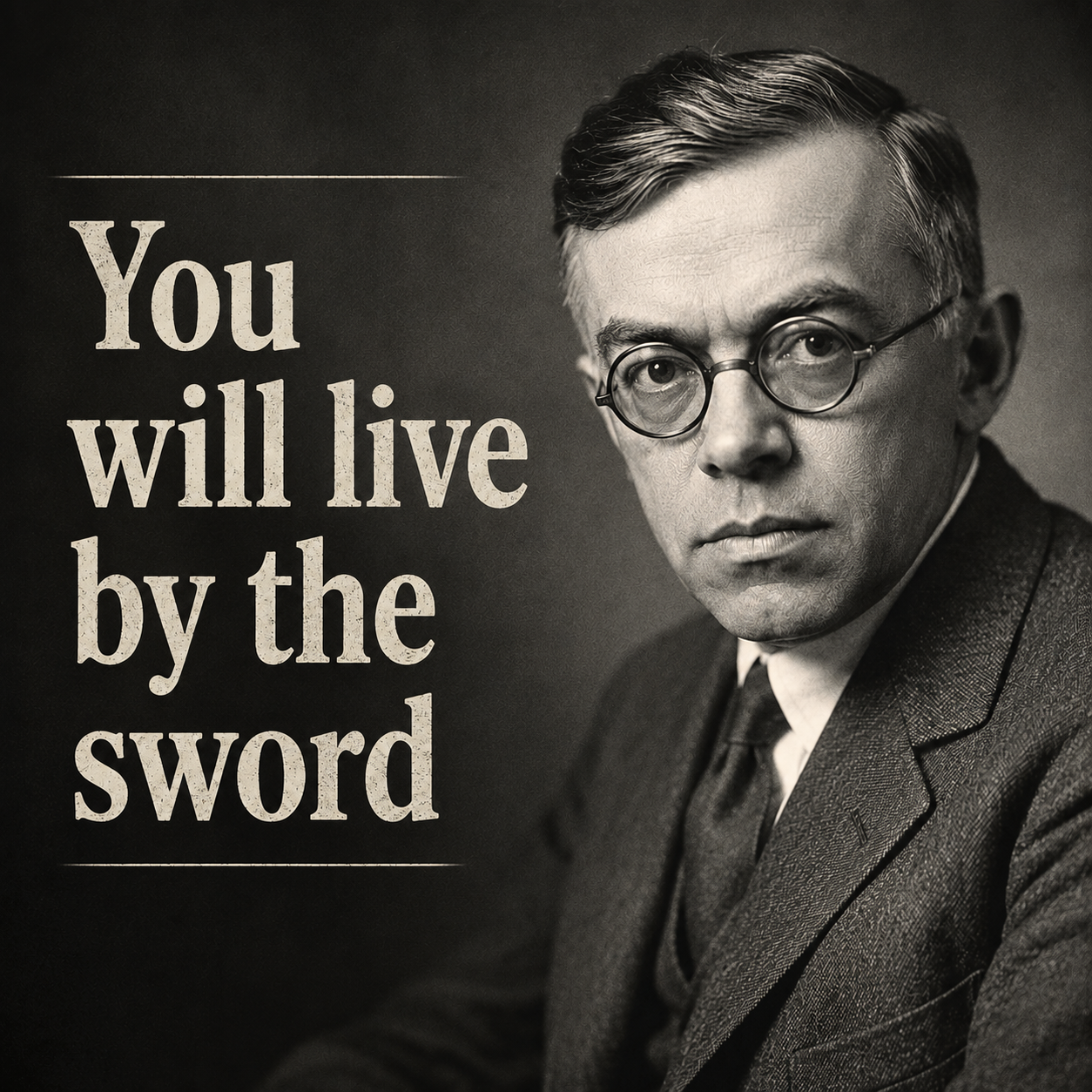
Unfortunately, this is all still relevant today. Menachem Begin, Jabotinsky's disciple, announced that the movement was entering the era of "military Zionism" and rewrote the Betar oath — where members had once sworn to use strength only in defense, Begin's version added conquest. Begin's party became the Likud; the Likud has led Israel for most of the years since 1977. Jabotinsky's personal secretary, Ben-Zion Netanyahu, described military service as "a sublime value that the state is based upon" — not a duty, a value the state rests on — and his son has been prime minister longer than anyone in the country's history. Asked in 2015 whether Israel would forever live by the sword, the younger Netanyahu answered in one word: yes.
Set that answer next to Rabbi Hirsch, writing before any of these men were born, teaching that a civilization which honors the sword will never escape it. The two positions are not variations on one tradition. They are the tradition and its replacement.
The point, as always
The purpose of this history is not to argue about any current war — this series has deliberately stayed out of that. The purpose is narrower. When observers watch the state's martial culture and call it "Jewish militancy," or when its leaders wrap the sword in the vocabulary of Sinai, both are repeating the same error this series has documented from the beginning: mistaking a manufactured national character for the religion it replaced. The martial ideal came from Cahan's blood-and-fire romanticism, from interwar Europe, from a man his own colleagues compared to the century's tyrants — and it was imposed on the image of a people whose sages had spent centuries teaching the opposite. Those sages have heirs. They still teach the opposite. And nothing done by the sword is done in their name.
Next, the series concludes: who is a Jew? Two answers — the covenant's and the state's — and why the difference decides everything else.
The Law of the Land Is the Law