Inventing the New Hebrew
Third in a series on Zionism, Judaism, and why the difference matters. Read part one here and part two here.
The first two articles in this series established a pattern: the founders of Zionism had left the Jewish religion behind, and in its place they built a new object of devotion — the nation itself, fused mystically to its land. But a new religion needs more than a new god. It needs a new kind of believer. And the early Zionists were remarkably candid about the fact that the existing Jew, the Jew shaped by three thousand years of Torah, would not do. He would have to be remade.
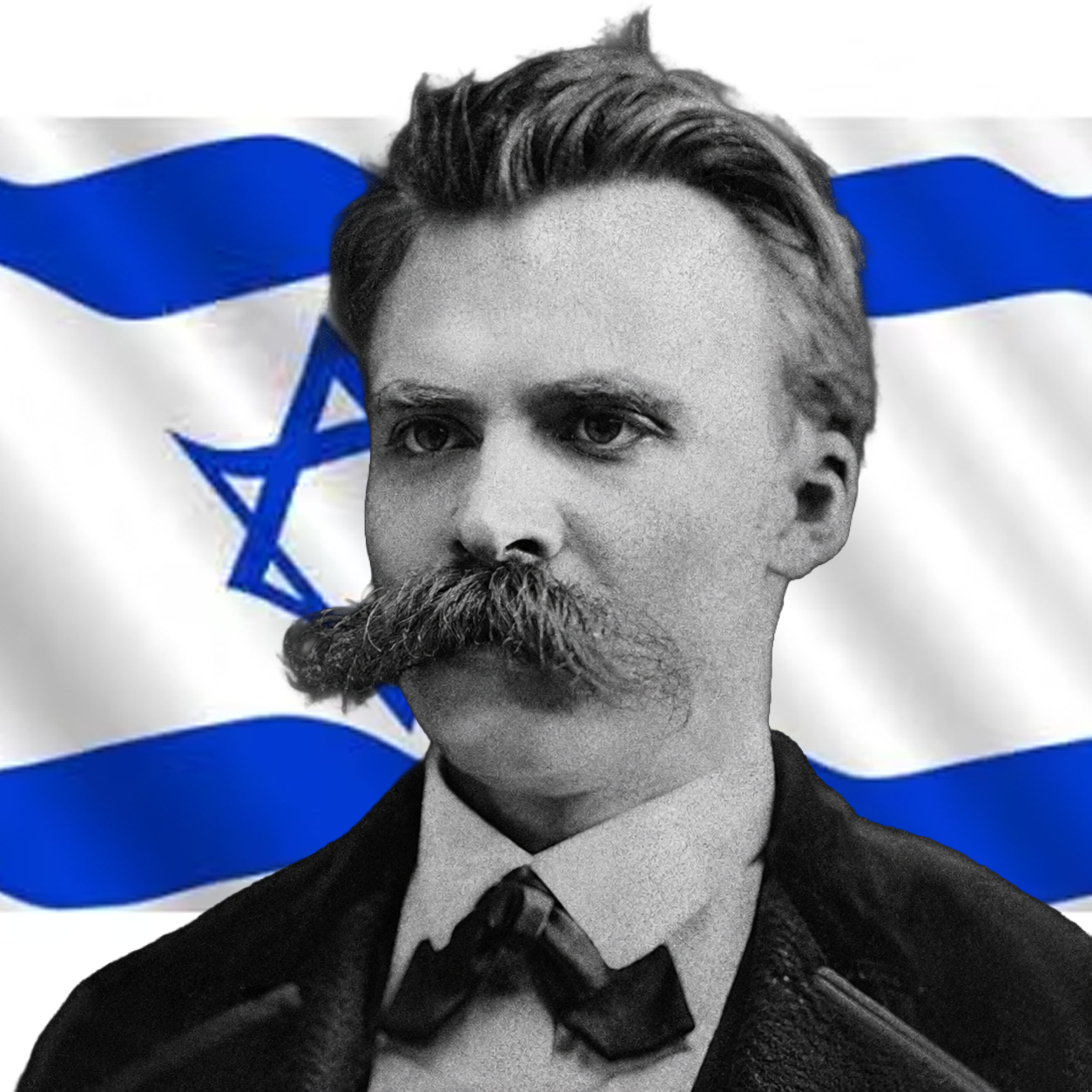
The blueprint for remaking him came from an unexpected source: a German philosopher who despised religion in general and the Judeo-Christian moral tradition in particular.
The philosopher of the hammer
Friedrich Nietzsche died in 1900, just as Zionism was organizing itself into a movement. His ideas were electrifying Europe. God, he announced, was dead — and with him, the entire moral inheritance built on faith. What passed for virtue, Nietzsche argued, was really two rival systems. There was "slave morality," which prized humility, mercy, and kindness — the values of the weak, canonized by religion to console themselves. And there was "master morality," which prized strength, pride, and nobility — the values of the strong-willed, who take what life offers rather than waiting for a reward after death.
Nietzsche called for a "transvaluation of values": the deliberate overthrow of the old moral order and its replacement by the new. The human ideal that would carry out this overthrow he named the Übermensch — the Superman — a figure unbound by conventional morality and powerful enough to remake values in his own image.
For Zionism, a movement whose whole purpose was to escape their inherited religion, Nietzsche's philosophy was a veritable instruction manual.
The reception
The paper trail here is unusually rich, because the early Zionist writers didn't just absorb Nietzsche quietly. They celebrated him.
As early as 1894 — three years before the First Zionist Congress — David Neumark published a Hebrew essay introducing Nietzsche's theory of the Superman, translating Übermensch as Adam Elyon and holding it up as a model for the new Hebrew man. David Frishman translated Thus Spoke Zarathustra, the book of the Übermensch, into Hebrew; Martin Buber translated it into Polish. Chaim Weizmann, later the first president of Israel, recommended Nietzsche's work warmly in a letter to his future wife. Jabotinsky called him a giant.
The writer Micha Yosef Berdyczewski, one of the most influential Hebrew authors of the era, declared himself a Nietzschean outright, writing to a friend: "I am a Nietzschean... and know only might, power, power!" He called for the Jewish people to "shake the foundations of their heritage and create new values" — Nietzsche's transvaluation, applied directly to Judaism — and argued that the time had come to put "the Jews ahead of Judaism." The Zionist writer Reuven Breinin promised that thanks to the movement, the coming generations would no longer be "small and weak, beaten and sickly," but would instead be "a generation of giants... a generation of 'Supermen.'" The poet Yaakov Cohen completed the picture in 1912: "The New Hebrew will be the new human... proud and tall he will walk, like the ancient Hebrew."
None of this is a hostile reconstruction after the fact. Mainstream scholarship says the same. The literary historian Menachem Brinker concluded that it was Nietzsche's influence, above all, that radicalized the movement's break with the Jewish past; Steven Aschheim writes that classical Zionism enlisted Nietzsche precisely to articulate its ruptured relationship with that past and to drive its ideal of a self-created "Hebraic New Man."
What was being erased
To grasp what the New Hebrew was for, it helps to know what he was designed to replace.
The Talmud defines the Jewish people by three character traits: they are merciful, they are modest, and they perform acts of kindness. That self-definition held for millennia (and still does, for loyal Torah Jews). The traditional Jewish hero was never the warrior; he was the scholar — the pale student bent over a page of Talmud, the figure of patience, restraint, and charity. Jewish communities measured greatness in learning and piety, and regarded the cult of physical dominance as belonging to other nations, and to an older, crueler world.
Now set that portrait next to Nietzsche's categories. Mercy, modesty, kindness — the entire traditional Jewish character lands, item by item, in the column Nietzsche labeled "slave morality." This was exactly the diagnosis the Zionist writers embraced. The old Jew was weak, bloodless, bookish, and passive, they said, and his gentleness was not a virtue but a disease of exile. The cure was to build his opposite: proud instead of humble, hard instead of merciful, physical instead of spiritual, a man of soil and muscle instead of a man of the book. Berdyczewski put the program in a single chilling sentence: "There comes a time for an individual and for a people, to live by the sword, by power and the fist, by the vitality of being."
It cannot be stressed enough that this was a conscious project of inversion. The New Hebrew was not the old Jew updated for modern times. He was engineered, trait by trait, as the old Jew's photographic negative — and the engineers said so.
Why this matters now
The New Hebrew project succeeded well enough that its product is now familiar to everyone: the tough, tanned, secular Israeli — soldier, farmer, startup founder — celebrated in a hundred films and news features as the image of the modern Jew. Observers sometimes register the distance between that figure and the traditional Jewish ideal of humility and mercy, and conclude that a religion must have betrayed its own values.
The historical record points to a different conclusion. There was no betrayal, because there was no continuity to betray. The Israeli national character was manufactured in opposition to the Jewish religious character, by men who admired a philosopher famous for declaring God dead. When the two characters look nothing alike, it's not because Jews are hypocrites. It's because Zionists turned their backs on God and their own people.
Which means the equation runs backward once again. The state's persona tells you about Nietzsche, about European ideas of strength and nation, about a deliberate act of cultural engineering. It tells you nothing about Judaism, and nothing about the millions of Jews who still live by the older portrait — merciful, modest, and kind — and who never enrolled in the experiment.
Next in the series: how farming became a sacrament — the socialist pioneers, the kibbutz, and the strange religion of labor and soil.
Quotations from Berdyczewski, Breinin, Cohen, and others are drawn from David Ohana's "Zarathustra in Jerusalem: Nietzsche and the 'New Hebrews'" and related scholarship, including Menachem Brinker's work on Nietzsche's influence on Hebrew literature and Steven Aschheim's The Nietzsche Legacy in Germany*. Full citations available on request.*
The Law of the Land Is the Law