The Founders Didn't Believe in God
First in "The Great Conflation" — a series on Zionism, Judaism, and why the difference matters
You have probably absorbed a simple equation without ever examining it: Israel is the Jewish state, Zionism is the Jewish national movement, and therefore Judaism, Jews, and Israel are more or less the same thing wearing three different hats.
The assumption is understandable, but it is false — and the people best positioned to know it was false were the founders of Zionism themselves.
This series will make a claim that sounds radical but is, historically speaking, almost boring in its documentation: Zionism was not an outgrowth of the Jewish religion but a rebellion against it. Its architects said so, wrote so, and built their movement accordingly. And once you see that, something important follows for you as an observer of world events: the actions of the State of Israel are the actions of a political ideology and a nation-state — not of Judaism, and not of the Jewish people.
Start with the man who founded the state
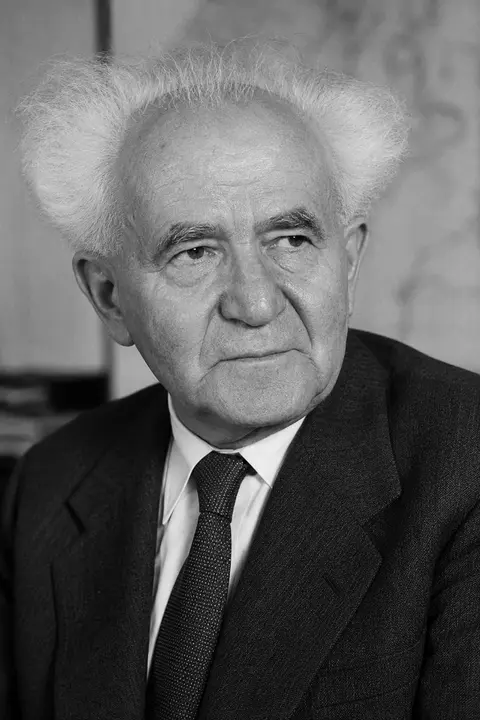
David Ben-Gurion, Israel's first prime minister, was asked about his relationship to the Bible he so often invoked. His answer deserves to be quoted at length, because most people have never heard it:
"Since I invoke Torah so often, let me state that I don't personally believe in the god it postulates... I am not religious, nor were the majority of the early builders of modern Israel believers."
That is the founding father of the Jewish state explaining that neither he nor most of his colleagues believed in the God of Judaism. He treasured the Bible, he said — but as a national epic, a land deed, a founding legend — not as anything a religious Jew would recognize as Torah.
Nor was this a private eccentricity; it was the movement's mainstream. The early Zionist leadership was drawn overwhelmingly from Jews who had left religious observance behind, often angrily, and who saw the traditional Jewish way of life — prayer, study, patient faith in exile — as precisely the disease they intended to cure.
"Give us a god"
A young Jew once approached Vladimir Jabotinsky — the intellectual father of the movement that became Israel's Likud party — and pleaded with him: our life is dull and our hearts are empty, for there is no god in our midst. Give us a god, sir, worthy of dedication and sacrifice, and you will see what we can do.
The young man was not asking Jabotinsky to bring him back to the God of his grandfathers — that God had been discarded. He is asking for a replacement — and Zionism supplied one. The nation itself became the object of devotion. Jabotinsky wrote it plainly: "There is only one god, one ideal: to rebuild the Jewish state."
A. D. Gordon, the philosophical voice of Labor Zionism, taught that the nation "created man," that it is "the source of our soul," that individuals are merely "cells in the body of the nation." The poet Bialik, at the opening of the Hebrew University in 1924, praised the young pioneers for elevating physical labor "to the level of supreme holiness, to the status of a religion."
These are not the words of people practicing Judaism; they are the words of people building a new religion — a religion of nation, land, and labor, assembled from the ideological materials of nineteenth- and twentieth-century Europe: romantic nationalism, socialism, and the rest. In later articles we will examine those borrowed materials one by one. For now, the point is simple: whatever this new faith was, its founders knew it was not the old one. Escaping Judaism was the entire point of their mission.
Some went further than unbelief
It was not merely that the founders were secular. Many of the movement's leading writers were openly hostile to Judaism and said they intended to replace it. Micha Yosef Berdyczewski, one of the most influential Hebrew writers of the era, described himself as a devotee of Nietzsche, argued that traditional morality had damaged the Jewish people, and called openly for creating "new values" to supplant the inherited ones. The celebrated poet Shaul Tchernichovsky — whose face appears on Israeli currency today — wrote an ode to the Greek god Apollo in which he presents himself as the first Jew to "return" from the Torah to paganism (!).
You do not have to take a rabbi's word for this. The Zionist thinkers announced it themselves, in print, with pride. The movement's own scholars have documented it exhaustively. The historian Steven Aschheim, for example, notes that classical Zionism enlisted Nietzsche precisely to articulate its broken relationship with the Jewish past.
Why a religious Jew is telling you this
I am a religious Jew. My community — and traditional Jewish communities like it around the world — has maintained the actual continuity of Judaism: the same Torah, the same law, the same prayers, the same understanding of what a Jew is and what exile means, carried unbroken across millennia. From within that tradition, the great rabbinic authorities of Europe opposed Zionism from its birth, and communities of Torah Jews continue to stand apart from it today — not because they lacked love for the land of Israel (Jews have prayed facing Jerusalem three times a day for two thousand years) but because they recognized the new movement for what its founders openly declared it to be: a secular nationalist project that redefined the Jew as a member of an ethnic nation rather than a servant of God.
Why should any of this matter to you?
Because the equation you were handed — Jew equals Zionist equals Israel — is doing real damage in the world, in at least two ways.
First, it teaches people to hold Jews responsible for the conduct of a state. When Israel acts, synagogues in London and Brooklyn get vandalized, and Jewish schoolchildren in Paris get harassed — as though a religious family in the diaspora were a branch office of a government they may oppose, and whose founding ideology their great-grandparents may have resisted from the very beginning. That is a critical category error, and tragically, it fuels antisemitism.
Second, it allows the State of Israel to speak in the name of all Jews — to wrap political and military decisions in the mantle of a four-thousand-year-old faith whose God its founders did not believe in. Judaism deserves better than to serve as branding.
Untangling the two is therefore not an attack on anyone but a clarification that protects everyone: it lets you evaluate a state's policies the way you would evaluate any state's policies, and it lets Jews be what they have always been — a religious community defined by Torah, not a nationality defined by a government.
That untangling is what this series is for. Next time: how European romantic nationalism — the ideology of blood, soil, and the mystical nation — became Zionism's substitute for faith, and why it represents everything the Jewish tradition is not.
Sources for quotations in this article include Ben-Gurion's Recollections*, the writings of A. D. Gordon and V. Jabotinsky, and scholarly treatments including David Ohana's "Zarathustra in Jerusalem" and Steven Aschheim's* The Nietzsche Legacy in Germany*. Full citations available on request.*
The Law of the Land Is the Law