Jews Come in Every Color

This week, the State of Israel’s official account on X posted a video of Titi Aynaw, a former Miss Israel who was born in Ethiopia and came to Israel as a child. In it, she talks about what it means to her to be, in the post’s words, “Black, Jewish, and Israeli.” The post ended: “Her identity is not up for debate.”
Nobody here is debating it. Her story is worth hearing, and it makes a point that deserves more attention than it usually gets, though not quite the point the post intended. Those three words, Black, Jewish, and Israeli, describe three different kinds of things: a race, a religion, and a citizenship. Much of the confusion in public discussion of Jews comes from running them together.
A people of every color
Anyone who spends time in an observant Jewish neighborhood in New York, London, or Jerusalem will see Jews of every complexion. There are Jews whose families came from Poland and Hungary, and Jews whose families came from Yemen, Iraq, Morocco, and Iran. There are the Bene Israel and Cochin Jews of India. There are the Jews of Ethiopia, Ms. Aynaw’s community, who lived for many centuries in the mountains of northern Ethiopia, kept their own form of the Torah’s law, and longed for Jerusalem in their prayers.
They do not share a race. Put a Jew from Sana’a beside a Jew from Vilna and a Jew from Gondar, and nothing in their appearance would tell an outsider they belong to the same people. What they share is the Torah, its commandments, and the covenant their ancestors accepted at Sinai.
The door that is always open
The clearest proof that Jewishness is not a race is that a person can join it. No one can convert to being Swedish by blood, or Korean. But anyone, of any background, can become a Jew by accepting the Torah and its commandments before a rabbinical court. From that moment on, the Torah treats the convert as fully Jewish, with no difference in standing.
The tradition holds converts in great honor. King David descended from Ruth, a Moabite woman who joined the Jewish people. Onkelos, whose Aramaic translation of the Torah is printed in nearly every edition of the Five Books of Moses today, was a Roman convert. In the twelfth century, a convert named Ovadiah wrote to Maimonides to ask whether he could say the prayers that speak of “our fathers.” Maimonides answered that he certainly could, because Abraham, the first Jew, is the father of every convert. “Do not think little of your lineage,” he wrote. “If we trace our descent to Abraham, Isaac, and Jacob, you trace yours to the One who spoke and the world came into being.”
A tradition that writes this way about converts is not describing a race.
How the question was decided
The Jews of Ethiopia are a good example. When they came to wider Jewish attention in modern times, rabbis examined their status by applying the Torah’s own law. The answer did not depend on their skin, their DNA, or their nationality. It depended on the questions Jewish law always asks: about their descent, their practice, and their relationship to the Torah.
Jewish identity has always been decided this way. It is a religious question with religious rules, answered by people trained in those rules.
Where the confusion comes from
If the Torah defines who is a Jew, why do so many people, Jews included, speak of Jewishness as an ethnicity or a nationality?
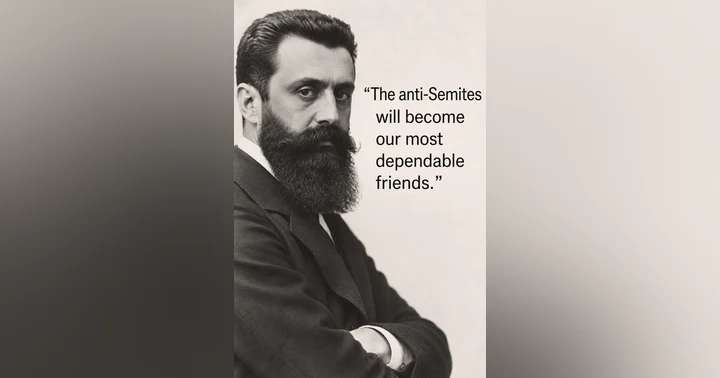
Much of the answer lies with Zionism. The movement’s founders, most of whom did not believe in the Torah, needed a definition of the Jewish people that did not depend on it, and they chose nationality. The Jews, Theodor Herzl wrote, are “a people, one people,” a nation like any other that needed only a state of its own. Once the Jews are seen as a nation rather than a community of faith, being Jewish starts to look like being French or Italian, a matter of birth and ancestry expressed through a country.
The State of Israel inherited that definition, and its own law shows the result. Under Israeli law, a Jew who rejects every religion, including Judaism, still counts as a Jew for the purposes of citizenship, while a Jew who adopts another religion does not. To the state, Judaism is one feature of a national culture, much like a national flag. A citizen who ignores the flag remains a citizen, but one who flies another country’s flag has changed sides. That is the logic of nationality, and the Torah does not share it.
Proud of her country
Ms. Aynaw is an Israeli citizen, and she is proud of her country. There is nothing strange about that. Jewish tradition teaches Jews to seek the welfare of the countries where they live and to pray for their governments. A Jew in Ohio who loves America and a Jew in Manchester who loves Britain are doing the same thing she is.
The trouble begins when a citizen’s pride in her country is presented as the meaning of being Jewish. When the State of Israel’s official account places “Jewish” and “Israeli” side by side as though they were two words for one identity, it is speaking for Zionism, not for Jews. Most Jews in the world are not Israeli. Many observant Jews, in Israel and outside it, reject the idea that a state speaks for their religion. A Black Jew in Brooklyn or a Yemenite Jew in London is no less Jewish for holding an American or a British passport.
What unites them
Told plainly, Ms. Aynaw’s story supports a simple point. Jews come in every color because Jewishness was never a matter of color. It is a bond to the Torah, carried by families on every continent and open to anyone willing to take it on. A state can give a person citizenship, and a person can be proud of the state that gives it, but the state does not define who is a Jew. The Torah does, and it did so long before there was any such state.
A Man Without a Country