The Balfour Declaration's Heavy Cost
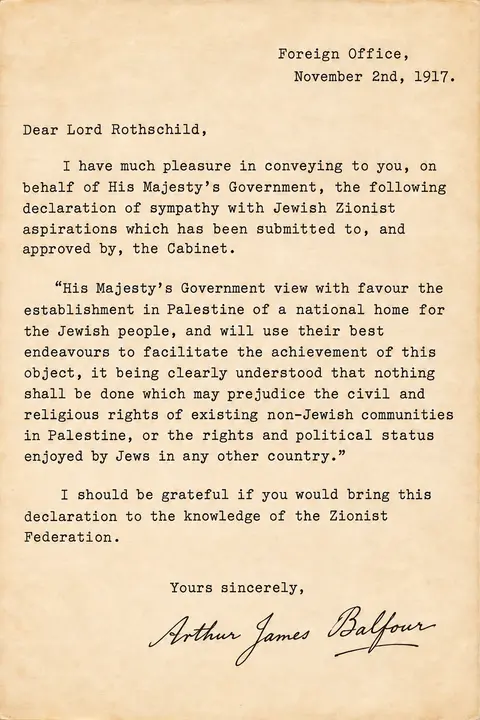
On November 2, 1917, the British Foreign Secretary, Arthur James Balfour, sent a short letter to Lord Rothschild, a leader of the British Jewish community, and asked him to pass it on to the Zionist Federation. Its central sentence announced that “His Majesty’s Government view with favour the establishment in Palestine of a national home for the Jewish people.”
Every year on this date, Zionist organizations mark the anniversary with dinners and speeches, and the letter is remembered as the charter that made the State of Israel possible. Torah Jews have reason to remember it differently. The Balfour Declaration did not come from the Torah, and the Torah authorities did not ask for it. A political movement that claimed to speak for the Jewish people obtained it, and the Jewish people, especially those living in the Holy Land, have been paying for it ever since.
Who asked for it
The letter was the result of years of lobbying by the Zionist movement, led in Britain by the chemist Chaim Weizmann. The rabbis of the old Jewish community in Jerusalem, the communities in Chevron and Tzfas that had lived under Ottoman rule for generations, and the leading Torah authorities of Europe had no part in it. They had not asked any government for a “national home.” They lived in the Holy Land, or prayed for it, as Jews had for centuries: as a religious community waiting for a redemption that God would bring in His time.
The one Jewish member of the British cabinet at the time, Edwin Montagu, opposed the declaration bitterly. He was no Torah scholar, but he saw the danger clearly. If a government announced that the Jews had a national home somewhere else, he argued, every Jew in Britain and elsewhere would be treated as a foreigner in his own country. His objection was taken seriously enough that the final text added a promise that nothing would be done to harm “the rights and political status enjoyed by Jews in any other country.”
That promise was written into the declaration because the danger was real. It has not held.
What it changed in the Holy Land
Before 1917, the religious Jews of Jerusalem, Chevron, and Tzfas were a minority living among Arab neighbors under a foreign government. Relations were not always easy, but they were the relations of a religious community with the people around it. The Balfour Declaration changed that. Now that a great power was backing the Zionist movement’s claim to the land, many Arabs came to see every Jew in Palestine as part of a political project to take the country from them. Religious Jews who wanted nothing to do with the project were treated as part of it all the same.
The worst result came in 1929. For months, Zionist activists had been demanding control of the area at the Western Wall, which was under Muslim administration, as it had been for centuries. Rabbi Yosef Chaim Sonnenfeld, the leading rabbi of Jerusalem’s old community, begged them to stop declaring publicly that the Wall belonged to the Jews, and warned that it would provoke violence. The British authorities warned them too. In August 1929, on the fast of Tisha B’Av, members of Jabotinsky’s Betar youth movement, who did not keep the Sabbath or the commandments, marched to the Wall and raised the Zionist flag there. Within days, rioting spread across the country.
In Chevron, Arab mobs attacked the ancient Jewish community and the yeshiva students living there. Sixty-seven Jews were murdered. Most of the victims belonged to the old religious community and the yeshiva. They had nothing to do with flags, marches, or demands for sovereignty. The guilt for the murders belongs to the murderers. But the warnings had been given, and the people who ignored them were not the people who died.
What it changed in the Torah world
The declaration also did damage within the religious world itself.
Jewish tradition teaches that the Jewish people are bound by three oaths, described in the Talmud, not to end the exile by their own power. Among other things, the oaths forbid rebelling against the nations and taking the land by force. For centuries this teaching stood in the way of any political movement to establish Jewish rule in the Holy Land. Religious supporters of Zionism needed a way around it, and the Balfour Declaration gave them one. They argued that the nations themselves had now given permission, so the oaths no longer applied.
That argument has been repeated ever since, and it does not hold up against the facts. The declaration promised a “national home.” It never promised a sovereign state. When the United Nations voted in 1947 on partitioning Palestine, Britain abstained, and it was preparing to hand the country over to an international trusteeship, not to a Jewish government. The state declared in 1948 was not received peacefully from anyone. It was established through war against the Arabs of the land, and before that through an armed campaign against the British themselves. A letter from 1917 could not turn any of that into the peaceful permission the religious argument depends on. One letter often cited in support of the argument is attributed to the great Rabbi Meir Simcha of Dvinsk. It first appeared in a Zionist publication without any original manuscript, and there is serious evidence that it is a forgery.
What it made of every Jew
The leaders of the Zionist movement understood early what the declaration would require. In his 1923 essay “The Iron Wall,” Vladimir Jabotinsky wrote that no native people had ever agreed to be settled by another, and that the Arabs of Palestine would not agree either. The project, he concluded, could go forward only behind an “iron wall” of force. A national home announced over the heads of the people living in the country could only be built that way, and in the century since, a great many lives have been lost on every side.
The cost has not stayed in the Middle East. Montagu’s warning came true in ways he could not have imagined. Because a state was founded on the claim that it is the home of the whole Jewish people, Jews everywhere are viewed as its representatives. A synagogue in Europe or America becomes a target for anger at a government thousands of miles away, and a Jew who has never set foot in Israel is asked to answer for it. The declaration’s own logic broke its promise to protect “the rights and political status enjoyed by Jews in any other country.”
How Torah Jews remember the date
This publication takes no position on the politics of the region, but the history of November 2 should be told accurately. The Balfour Declaration was a gift from an empire to a political movement. The Jews who paid most dearly for it were often the ones who never asked for it: the old communities of the Holy Land, the students of the Chevron yeshiva, and Jews around the world who have been made to answer for a state that does not speak for them.
Torah Jews do not celebrate the anniversary. They remember the people who were lost because of what followed. And they pray, as they always have, for peace for everyone who lives in the Holy Land, and for the redemption that will come from God, not from a letter written by a foreign minister.
Judge Them by How They Treat Jews