The Israeli Election, not the Jewish Election
Israel voted on Tuesday, and the count is now nearly complete, but the country still does not know who will govern it. Neither of the two main blocs came close to the sixty-one seats needed for a majority in the Knesset. Benjamin Netanyahu’s bloc has about fifty-three, the opposition bloc led by Gadi Eisenkot has about forty-eight, and the Arab parties hold the rest. Over the coming weeks the party leaders will bargain, make offers, and rule things out. The talks may produce a government, a fragile minority arrangement, or another election.
The commentary has not waited for the outcome. Headlines speak of a nation divided, of Israel at a crossroads, of a deadlocked Jewish state. Many readers will hear something slightly different in that language. They will hear that the Jews are divided, and that whatever government finally emerges will be the choice of the Jews.
So it helps to be precise about who actually voted, because the answer matters a great deal for Jews who had nothing to do with it.
Who cast the votes
The people who voted in this election were the citizens of Israel. About a fifth of them are Arab citizens, and the Arab parties they elected will hold more seats in the new Knesset than they have in years. Israel’s Jewish citizens divided their votes among a dozen parties with sharply different visions. Some of the most observant communities in the country, the ones that have opposed Zionism since before the state existed, did not vote at all.
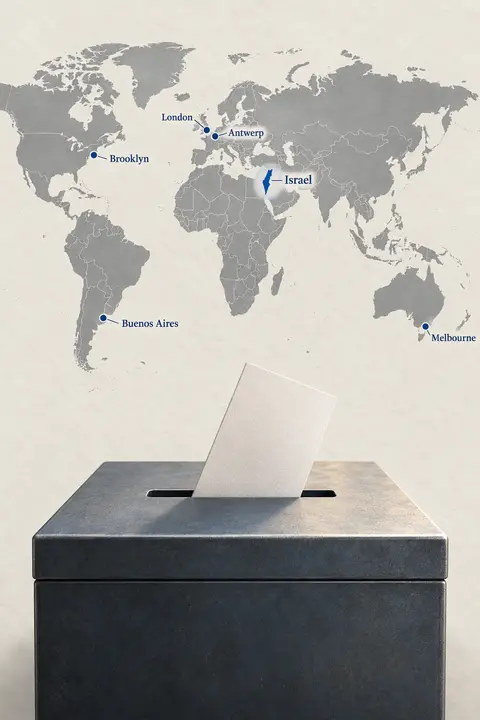
And roughly half of the world’s Jews did not vote, because they do not live in Israel and are not its citizens. A Jewish family in Brooklyn, Manchester, Antwerp, Buenos Aires, or Melbourne had no ballot in this election. Neither did their rabbis, their synagogues, or their communal institutions. Whatever government comes out of the coming negotiations, it will not have been their decision.
What the result is, and what it is not
Whoever forms the next government will have a mandate from the voters and the coalition partners who put it there. That is how parliamentary democracies work, and it is the only mandate any government has. The new government will make decisions about war and peace, borders, the economy, the courts, and much else, and it will answer for those decisions to its citizens and to the world, as every government does.
What it will not have is a mandate from the Jewish people. A state that calls itself “the Jewish state” can claim to speak for every Jew on earth, but no Jew outside Israel gave it that authority, and the state's claim does not make it true. The Torah tradition never gave it that authority either. When the movement first proposed a political state speaking in the name of the Jews, the leading Torah authorities of the time rejected the idea, and their heirs still reject it today.
The same mistake from two directions
Two kinds of reaction are already appearing abroad, and they make the same mistake.
Some supporters of one side treat the outcome as a test of the Jewish people’s future. Some opponents of the State treat Jews in their own cities as though they had cast ballots in Tuesday’s vote. The first group means it warmly and the second means it with hostility, but both are saying that any Jew, anywhere, has a stake in the outcome of a foreign election and shares responsibility for it.
That idea is the one this publication has argued against since its first article, because it is the idea that turns synagogues and Jews around the world into targets. A Jew in London is no more responsible for the next Israeli government than a Catholic in Chicago is responsible for the next government of Italy. Saying so takes no political side; it simply describes accurately who decides what. The point applies equally to whichever coalition eventually takes office, and to a second election if that is where this ends.
What Torah Jews are doing this week
Observant Jews around the world are not waiting anxiously on the coalition talks. They are doing what Jewish tradition has asked of them for twenty-six centuries, ever since Jeremiah wrote to the exiles in Babylon. They are seeking the peace of the cities where they live, going to work, raising their families, and keeping the law of the land. And they are praying: for peace, for an end to bloodshed in the Holy Land for everyone who lives there, and for the safety of Jews everywhere.
None of that depends on who ends up in charge. Sooner or later a government will be formed, and it will be the government of a country, answerable for itself. The Jewish people, and the Torah they carry, were not on the ballot.
The Jewel and the Donkey