The Law of the Land Is the Law
Second in the series “Seek the Peace of the City,” on what Judaism teaches Jews about the countries they live in. Part I is here.
The previous article described a letter. Jeremiah told the Jewish exiles in Babylon to build houses, raise families, and seek the welfare of the city where they had been sent. The prophet’s guidance set the direction. But a direction is not yet a rule, and a people living under foreign governments for centuries needed something more precise. When a Jew’s obligations to his own law and to the king’s law seemed to point different ways, which one governed?
The answer came from Babylonia again, about eight hundred years after Jeremiah’s letter arrived there.
Four words
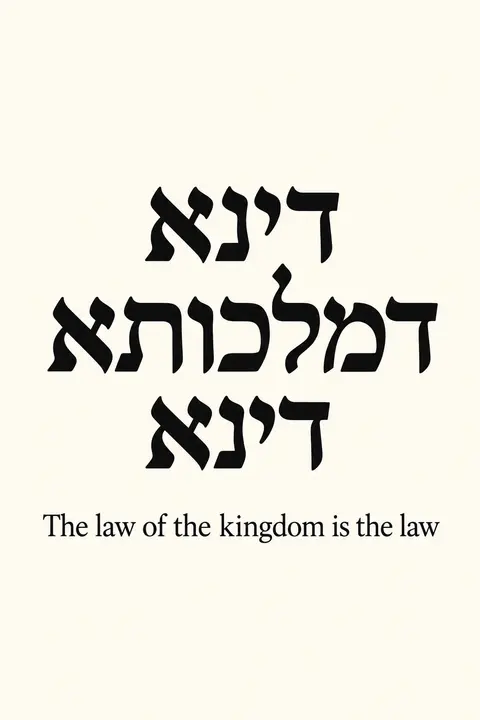
In the third century, one of the leading sages of the Babylonian Jewish community was a scholar named Shmuel. He was a judge and a teacher, and by the Talmud’s account an astronomer and physician as well. Of the many rulings recorded in his name, one has had an influence far beyond the rest. In the Talmud’s Aramaic it is four words long: dina d’malchusa dina. The law of the kingdom is the law.
The principle appears in several places in the Talmud, applied to practical cases: taxes, land ownership, legal documents, the government’s rights over property. Each time the conclusion is the same. Where the government of the land has established a legitimate law, Jewish law itself requires a Jew to obey it.
That last point is easy to miss, but it's the important one. Shmuel was not saying Jews should obey the government because they had no choice, or because it was prudent, or because disobedience might bring trouble on the community. All of that was true, but it was not his point. He was saying that the law of the land binds a Jew as a matter of Jewish law. A Jew who evades a legitimate tax is not only breaking the king’s rule. He is breaking a rule of his own religion.
What it covers
Over the following centuries, the great legal authorities explained the principle’s scope in detail, and it reaches far into ordinary life.
Taxes are the clearest case. The codes of Jewish law treat a legitimate tax as a real debt, and evading it as a form of theft. The principle also covers customs duties, property records, the rules governing contracts and commerce, and the government’s authority to build roads and keep public order. In many areas, a Jewish court applying the Torah’s own civil law will defer to the law of the country, because the Torah’s law instructs it to.
In practice, this means the observant Jew’s religion stands behind his country’s civil law. When a rabbi rules on a business question today in New York or London, he is expected to take local law into account, and in many areas he will treat it as binding on the parties before him.
What it does not cover
The principle has limits, which an honest account must describe, because they show what kind of loyalty it actually asks for.
First, the law of the land governs civil matters. It does not override the Torah’s religious commandments. No government decree can permit a Jew to violate the Sabbath, eat forbidden food, or worship another god, and the authorities never read Shmuel’s words as saying otherwise. Citizens of many faiths would recognize the distinction: a believer can obey his country’s laws in full and still decline to do what his conscience forbids.
Second, and less familiar, the principle applies only to legitimate law, and the authorities defined legitimacy carefully. Maimonides, writing in the twelfth century, ruled that a king’s law is binding when it applies to everyone alike. A decree aimed at one group to plunder it, or a tax levied arbitrarily on one person, has no force of law at all. It is simply robbery carried out by someone with power. In Jewish law, then, a valid law is a law that treats its subjects equally.
A minority that had suffered more than its share of arbitrary decrees built into its religious law a standard of fairness that modern democracies would recognize as their own: law is law because it applies to all. That standard did not make Jews less loyal to the governments that met it. It defined what loyalty was owed to.
What the principle means for the old accusation
The charge of divided loyalty imagines a Jew who obeys his country’s laws only outwardly, while his real allegiance lies elsewhere. Shmuel’s principle describes the opposite. It puts the country’s legitimate law inside the Jew’s own religious obligations, so that obeying it is part of serving God. The observant Jew who files an honest tax return, honors a contract made under civil law, and respects the authority of the courts is doing what his own tradition commands.
Of course, that doesn't mean every Jew lives up to it. Individuals in every community sometimes fall short of what's expected of them, and Jewish communities also have some people who cut corners. But when they do, they are violating Jewish law, not following it, and the tradition’s authorities have said so plainly and often. The standard is clear, and it has been clear for seventeen centuries.
Jeremiah told the exiles to seek the peace of the city. Shmuel told them, in four words, that the city’s law was their law. The next article turns to the third part of that inheritance: the prayer Jews have said for their governments, in synagogues around the world, every Sabbath for centuries.

The Letter to the Exiles