Thoughts of an American Jew on America's 250th Birthday
This week, America celebrates two hundred and fifty years.
I will be celebrating too. And I want to explain why — because my reasons may not be what you expect.
I am an Orthodox Jew. And according to the government of Israel, and according to Zionist organizations around the world, my true home is not here. They say I belong to a different nation, that a state in the Middle East is my real homeland, and that my presence in America is a kind of extended layover — an exile waiting to be corrected.
I reject that claim completely. And the Fourth of July is a good occasion to explain why.
Start with what America is.
America was founded by people who lived in a land and felt that the government ruling over them did not represent them. They were being governed from across an ocean, taxed without a voice, controlled by a power that did not answer to them. So they declared independence and built a government whose purpose was to serve the people who actually lived under it — to secure their rights, protect their freedoms, and let them control their own destiny.
That is the story of 1776. A government created by its people, for its people.
Now consider Israel, because its story is fundamentally different — and the difference is almost never explained to the non-Jewish world.
Israel was not created the way America was, by residents of a land throwing off a government that failed to represent them. Israel was created as a tool for an ideological project. And the architects of that project said so openly.
The founders of Zionism in the late nineteenth century were, by and large, Jews who no longer wanted Judaism. They had abandoned religious observance and hoped to blend into European society. But Europe would not let them. The pogroms that swept Russia and Eastern Europe in the 1880s, and the antisemitism that persisted even in "enlightened" Western Europe, convinced them that assimilation had failed.
So they chose a third path. If they could not stop being Jews, and did not want to be religious Jews, they would redefine what a Jew is.
This was the true heart of Zionism. Not a country — a transformation. The Jews had always been a religious community: a people defined by a faith, a Torah, a covenant. The Zionists set out to remake them as a nationality like all other nationalities — a nation defined by land, language, flag, and army, in the style of the nineteenth-century European nationalist movements from which Zionism borrowed its entire vocabulary.
And for that project, a state was not the goal. A state was the equipment. A nation, as Europe understood nations, needed a territory, an anthem, a government, a modern language, a national culture. The state was the instrument through which a religion would be converted into a nationality — and through which religion itself would be made obsolete.
The early Zionist thinkers said this plainly. Their writings are full of it. The state was the means. The new Jew — secular, national, freed from the "burden" of religion — was the end.
Understanding this explains something that puzzles many observers: why the relationship between the Israeli state and traditional Judaism has always been so strained. People assume a "Jewish state" must be the natural friend of the Jewish religion. But a state founded on the project of replacing Jewish religion with Jewish nationalism is not the natural friend of that religion. It is its rival.
Nowhere is this clearer than in the Israeli army.
David Ben-Gurion, Israel's founder, described the army as the melting pot of the new nation — the institution that would take Jews from a hundred backgrounds and forge them into Israelis. That was not a side effect. That was a stated function. And Israeli generals and officials have repeated the same idea for decades: military service is where the transformation happens.
For a religious Jew, this is not an abstraction. It means the army is not merely a military institution but an ideological one — an instrument designed, from its birth, to pull Jews away from traditional religious life and remake them in the image of the new secular nation. That is why the question of drafting religious Jews has convulsed Israeli politics for seventy-five years. It has never been only about manpower. It is about the state's original mission.
If I lived in Israel, I would have to fear for my children — not fear of war alone, but fear of an institution whose founding purpose includes separating young Jews from the faith of their fathers.
Now come back to America.
Here, the government does not tell me what a Jew is. It does not claim my religion as raw material for a national project. It does not conscript my children into an ideological melting pot. The First Amendment — written into this country's founding law two and a half centuries ago — guarantees that I may practice my religion fully, openly, and without the state's interference or agenda.
I keep the Sabbath. I keep the dietary laws. I educate my children in the Torah. I do all of this freely, as an American citizen, under a government that regards my faith as none of its business — which is exactly how it should be.
That is why I am proud to be an American Jew. Not an Israeli-in-waiting. Not a member of some worldwide political nation headquartered in Tel Aviv. An American, whose religion is Judaism, living in a country whose founding idea — government by consent, freedom of conscience — has given Jewish religious life more room to flourish than the self-described "Jewish state" ever has.
There is a deep irony here that I hope non-Jewish readers will appreciate.
The country that never called itself Jewish has been a blessing for Judaism.
The country that calls itself the Jewish state was founded on the ambition of leaving Judaism behind.
When you understand that, much of the confusion surrounding Israel, Jews, and Zionism begins to clear. You understand why devoutly religious Jews have opposed Zionism since before Israel existed. You understand why the "Jewish state" and traditional Judaism are so often in conflict. And you understand why an Orthodox Jew in New York can watch the fireworks this week with genuine gratitude — not as a guest in someone else's country, but as a citizen of his own.
Two hundred and fifty years ago, this country was founded on the idea that governments exist to serve their people and secure their freedoms.
For this Jew, and for millions like me across American history, it has kept that promise.
Happy birthday, America.
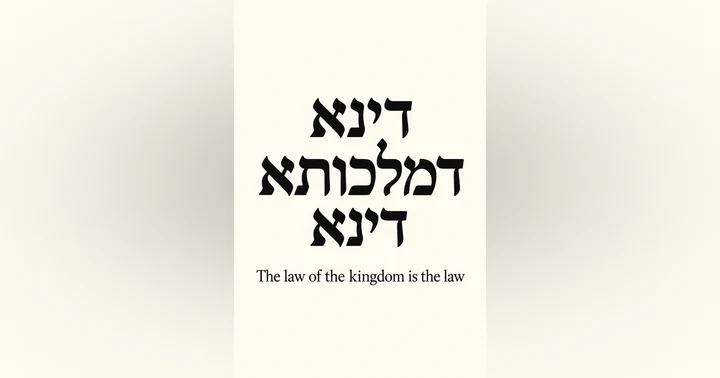
The Law of the Land Is the Law