What the Kastner Trial Revealed
The Zionist movement tells a simple story about the Holocaust. The Jews of Europe were helpless because they had no state, and the movement that set out to build one was their protector. In this telling, the State of Israel is the answer to Auschwitz.
In the 1950s, a courtroom in Jerusalem heard evidence that tells a very different story. The case concerned the Zionist leadership in Hungary in 1944, the last great Jewish community of Europe to be destroyed. It ended with an Israeli judge ruling that the movement's man in Budapest had "sold his soul to the devil." It became known as the Kastner trial. It brought down a government in Israel, and its central figure was shot dead in a Tel Aviv street. The Zionist establishment has spent the decades since trying to make the world forget it.
The deal
In March 1944, Germany occupied Hungary. Its Jewish community, some eight hundred thousand people, had lived through the war relatively untouched. Adolf Eichmann came to Budapest to send them to Auschwitz, and he had a practical problem. He had only a small number of SS men and a few thousand Hungarian gendarmes to round up and deport hundreds of thousands of people. If the Jews understood where the trains were going, they could resist, hide, or run, and some were already fleeing across the borders.
Eichmann needed the Jews kept calm and ignorant, and he found the help he needed in Rudolf Kastner.
Kastner was head of the Relief and Rescue Committee in Budapest. He represented the Jewish Agency of Palestine there, the governing body of the Zionist movement, and he was a member of David Ben-Gurion's Mapai party. Eichmann offered him a bargain. If the Jews of Hungary went to the trains without revolt or flight, Kastner could save a group of Jews of his own choosing, about 1,685 people, on a train out of Hungary. Kastner and his associates would decide who got a seat, and many seats went to people who could pay large sums in ransom.
Kastner agreed. He chose his family, his Zionist associates, and the people who paid. From Kolozsvár (Cluj), his home city, he took 388 people, the most prominent members of the community, mainly Zionists. The other twenty thousand Jews of Kolozsvár were left behind.
The town was about three miles from the Romanian border. Kastner knew what Auschwitz was. Had he told the Jews of Kolozsvár the truth, they could have overwhelmed their handful of guards and crossed into Romania. Instead, he and the local Zionist leaders, who were the recognized leaders of the community, used their standing to calm the people and quiet anyone who raised an alarm. The Jews of Kolozsvár, like the Jews of the Hungarian provinces generally, boarded the trains believing they were being resettled.
Eichmann himself later described the arrangement. Kastner, he said, "agreed to help keep the Jews from resisting deportation, and even keep order in the collection camps," in return for letting a few thousand Jews go. "It was a good bargain." He added: "I believe that Kastner would have sacrificed a thousand or a hundred thousand of his blood to achieve his political goal. 'You can have the others,' he would say, 'but let me have this group here.'" Dieter Wisliceny, an SS officer who served under Eichmann, described the method plainly: "Our system is to exterminate the Jews through the Jews."
Between May and July 1944, about 437,000 Hungarian Jews were deported to Auschwitz. Most were murdered on arrival.
The money and the rabbis
The train did carry some people outside Kastner's circle. Among its passengers was the Satmar Rebbe, Rabbi Yoel Teitelbaum, who was then held in the Kolozsvár ghetto. He was on the train because Kastner's own father-in-law, Dr. Josef Fischer, insisted on it, and because a very large sum was raised to buy his seat. Funds raised by the Vaad Hatzalah in New York, the rescue committee led by Torah figures, including Rabbi Aharon Kotler, also went into the deal. The Rebbe was suspicious of the offer and checked whether it was real before he agreed to go. The seats on Kastner's train went to the well-connected and to those for whom money could be found. The masses had neither.
After the war
When the war ended, Kastner did one more service for the men he had dealt with. He testified on behalf of Kurt Becher, the SS officer who had handled the deal and collected the ransom, and helped him escape punishment for his part in destroying Hungarian Jewry. Years later, in an Israeli court, Kastner denied that he had ever done so.
By then, he was living in Israel, working as a spokesman for the Ministry of Trade and Industry, and he was a figure in the ruling party.
The trial
In 1952, Malchiel Gruenwald, an elderly Hungarian-born Jew in Jerusalem who had lost dozens of relatives at Auschwitz, published a pamphlet accusing Kastner of collaborating with the Nazis. Because Kastner was a government official, Israel's Attorney General, Chaim Cohen, sued Gruenwald for libel. Kastner himself did not want the case, and he had good reason. It quickly turned into an indictment of Kastner and of the entire Mapai party.
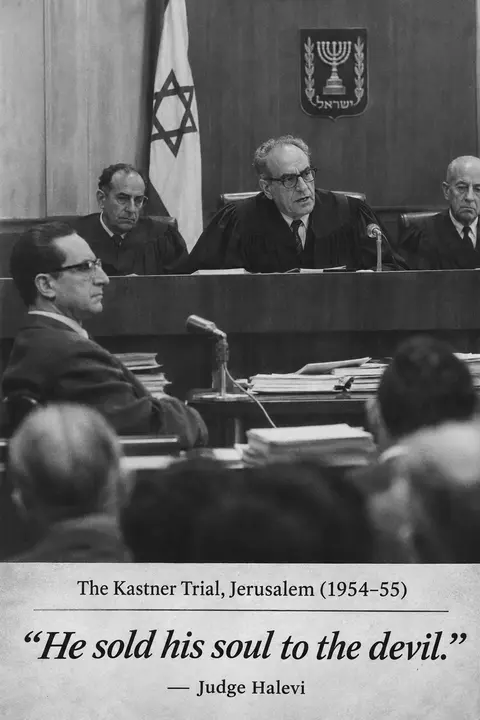
The trial ran from 1954 to June 1955. Judge Binyamin Halevi found for Gruenwald. He ruled that Kastner had collaborated with the Nazis in the destruction of Hungarian Jewry and had then helped save Kurt Becher. Kastner, he wrote, had "sold his soul to the devil."
The verdict shook the country, and Prime Minister Moshe Sharett's government fell. The state appealed. In March 1957, before the appeal was heard, Kastner was shot outside his car in Tel Aviv shortly after midnight. The gunman, Ze'ev Eckstein, had worked for the state's internal security service. He was convicted and released seven years later.
In January 1958, the Supreme Court reversed part of the verdict. By a vote of three to two, the judges held that Gruenwald had not proved beyond a reasonable doubt that Kastner was a Nazi collaborator. They upheld the finding about Becher, so the record still shows Kastner's help to the SS officer as criminal and perjured.
Keeping it quiet
The Zionist leadership understood the danger of all this becoming known. After the trial, the editor of Haaretz asked a journalist, Naphtali Lavie, to write about how the Jewish leadership in Palestine had behaved during the Holocaust. Lavie wrote three articles under the title "Why Did You Not Act?" Then he asked the editor to shelve them, "to avoid creating an atmosphere that we are guilty." The articles finally appeared long after much of the story was already known. They admitted that "in certain circles, suggestions were made to the effect that the rescue demands must not be allowed to overshadow other Zionist objectives."
This was not a slip by a few officials. Ben-Gurion had said as much in 1938, after the Kristallnacht pogrom. If he knew that all the children of Germany could be saved by bringing them to England, but only half by bringing them to the Land of Israel, he said, he would choose the second. The state came first.
In 1961, Ben Hecht, an American playwright who was himself a Zionist activist, published Perfidy, a book about the Kastner affair and the conduct of the Labor Zionist leaders during the war, Ben-Gurion among them. It was banned in Israel.
A different kind of leader
Some Jewish leaders in those years acted very differently. The contrast is the clearest judgment on Kastner.
In Slovakia, Rabbi Michoel Ber Weissmandl, a Torah scholar, fought to save every Jew he could reach. When the deportations from Hungary began, he wrote to Jewish leaders and the governments of the free world that twelve thousand Jews a day, men, women, and children, were being sent "to be gassed and burned." He sent maps of the death camps so that the railways and the camps could be bombed. "You are cruel," he wrote to his fellow Jews in the free world, "you are murderers, because of your folded hands which do nothing." Together with Gisi Fleischmann, he negotiated with the murderers themselves and made promises he could not keep in order to buy time. Even the Haaretz articles conceded that he delayed the slaughter and saved thousands.
Rabbi Weissmandl tried to save the many and warned the world, while Kastner saved the few and kept the many quiet. Rabbi Avigdor Miller, who lived through those years in America, concluded: "It was because European Jews put their trust in atheistic Zionist leaders that these leaders everywhere became the lackeys of the Nazis in all the ghettos. They were the machinery which served efficiently in the task of keeping the Jews docile and of persuading and coercing them to be sent off to their deaths. No Torah leader ever cooperated with the Nazis in the destruction machinery."
Saviors or betrayers?
The murderers of Hungarian Jewry were the Nazis and their Hungarian helpers, and the guilt is theirs. But the Zionist movement claims something for itself: that it is the guardian of the Jewish people. The Kastner trial tested that claim in a court of the movement's own state.
The record showed the movement's representative in Budapest bargaining with Eichmann and saving his family, his associates, and those who could pay. It showed him helping to keep hundreds of thousands of Jews ignorant until they reached Auschwitz. When the truth came out, the State of Israel defended him, prosecuted his accuser, and put off the reckoning for as long as it could.
That is the history behind the claim that the state is the answer to the Holocaust. The Jews of Hungary deserve to be remembered as they were: a great community, faithful to the Torah, murdered by the Nazis, and betrayed by the movement that claimed to speak in their name.

Jews Come in Every Color