What’s on the Ballot
On October 27, Israelis go to the polls to elect a new parliament. To an outside reader, the ballot can look bewildering: more than a dozen parties, alliances that formed only weeks ago, leaders who have switched parties several times, and a vocabulary of left, right, and center that doesn’t map neatly onto any other country’s politics.
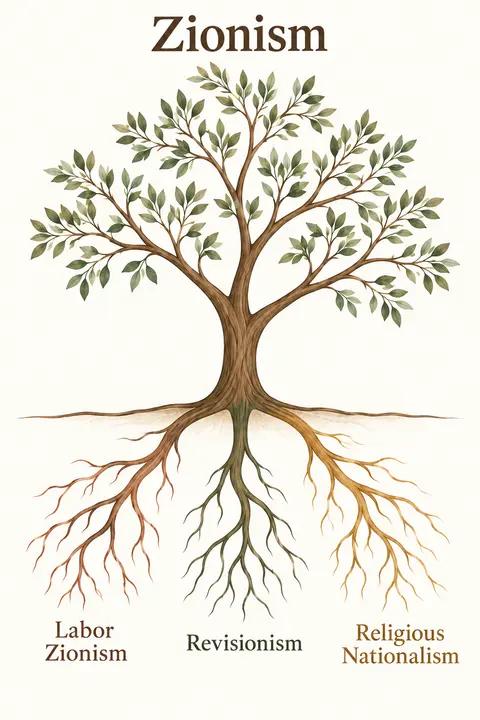
There is a simpler way to read it. Almost every major party on that ballot descends from one of the ideas that founded Zionism more than a century ago, and those ideas have family trees that can be traced. Knowing them makes the election far easier to understand. It also makes plain something news coverage rarely says: an Israeli election is a contest among versions of a political movement. What Judaism teaches is not on the ballot.
This publication takes no position on who should win. What follows is a map, not a recommendation.
The socialist branch
The party called the Democrats, formed in 2024 from the merger of the old Labor party and the left-wing Meretz, is the heir of Labor Zionism. That was the movement of the early pioneers: socialists from the Russian Empire who came to build collective farms and a workers’ society. Their philosopher, A. D. Gordon, taught that labor on the soil would make the Jewish people “normal” again. Their political leader was David Ben-Gurion, who declared the state’s independence in 1948 and whose party governed Israel without interruption for its first twenty-nine years.
Earlier articles in this publication traced where those ideas came from: the revolutionary politics of nineteenth-century Russia and the European veneration of the land and the worker. The socialism has faded considerably since then, and today’s party is better known for its positions on democracy and the conflict than for collective farms. But the line of descent is direct.
The Revisionist branch
Likud, the party of Prime Minister Benjamin Netanyahu, descends from the rival wing of the movement, founded by Vladimir Jabotinsky in the 1920s. Jabotinsky broke with the mainstream over how to deal with Arab opposition. In his well-known essay “The Iron Wall,” he argued that a Jewish state could be built only behind armed force. His youth movement, Betar, made military discipline a central value. His disciple Menachem Begin led the underground Irgun before 1948, founded the Herut party after independence, merged it into Likud in 1973, and became prime minister in 1977, ending Labor’s long rule.
Likud has governed for most of the years since. Its policies have shifted with its leaders, but its founding emphasis on strength, territory, and national pride comes straight from Jabotinsky, and the party still honors him as its founding father.
The religious-nationalist branch
Two parties on the ballot descend from the third major stream, the one this publication examined at length in its series on religious Zionism. The party called Religious Zionism, led by Bezalel Smotrich, is the heir of the Mizrachi movement founded in 1902 and of the National Religious Party that represented it for decades. After 1967 that camp was transformed by the teaching of Rabbi Avraham Yitzchak Kook and his son, which held that the State of Israel is the beginning of the messianic redemption and that conquered territory is prophecy being fulfilled. That doctrine became the engine of the settlement movement, and it remains the party’s ideological core.
Otzma Yehudit, led by National Security Minister Itamar Ben-Gvir, stands further along the same road. Its roots lie in the movement of Meir Kahane, whose Kach party Israel itself banned from its parliament in 1988. Readers of this publication have already met Ben-Gvir on the Temple Mount this summer, where he celebrated Jews “feeling like they’re the owners of the place,” contrary to the standing ruling of the state’s own Chief Rabbinate.
The press usually calls these the “religious” parties, and their voters are largely observant. That is exactly why the distinction matters. Their program rests on a doctrine that the leading Torah authorities of its own generation rejected, and that the tradition’s teaching on exile and redemption contradicts. A candidate’s personal observance does not turn his party’s platform into Judaism.
The center
Several parties present themselves as centrist. Yashar, the new party of former army chief of staff Gadi Eisenkot, is running roughly even with Likud in the polls. B’Yachad is the joint list of Naftali Bennett and Yair Lapid. Yisrael Beitenu is Avigdor Liberman’s secular nationalist party. They differ on many things, but they share mainstream Zionism’s general premise: that the Jewish people are a nation whose collective life is expressed through this state. They argue about how to govern it, not about whether that premise is right.
The parties outside the map
Not every party on the ballot belongs to these family trees. Two Arab parties, the Joint List and Ra’am, represent Israel’s Arab citizens, who make up about a fifth of the population. They are not Zionist parties at all.
There are also two Haredi parties, Shas and United Torah Judaism, which represent ultra-Orthodox communities. They are a different case from everything above, and they raise questions that deserve more than a paragraph. For now it is enough to say that they were not founded on Zionist ideology, and that some of the most strictly observant communities in Israel, including the Jerusalem communities that have opposed Zionism since before the state existed, do not vote in these elections at all.
What the election decides
Put the map together, and the choice before Israeli voters comes into focus. They are choosing among descendants of the movements that founded the state: the socialist branch, the Revisionist branch, the religious-nationalist branch, and a broad center that shares their basic premise. Voters will decide which of those traditions governs Israel for the next several years, and they will settle questions of real consequence for the people who live there.
What the election does not decide is anything about the Jewish religion. No party on the ballot speaks for the Torah, and no result will change what the Torah teaches about exile, redemption, or the place of a state in Jewish life. The government that emerges after October 27 will be the government of a country, and like every government it will answer for its own decisions. It will not be the voice of the Jewish people. Jews around the world, who will not cast a single vote in this election, owe it no more allegiance than they owe any other foreign government.
That point holds whichever party wins.
The Law of the Land Is the Law