Good Jews and Bad Jews
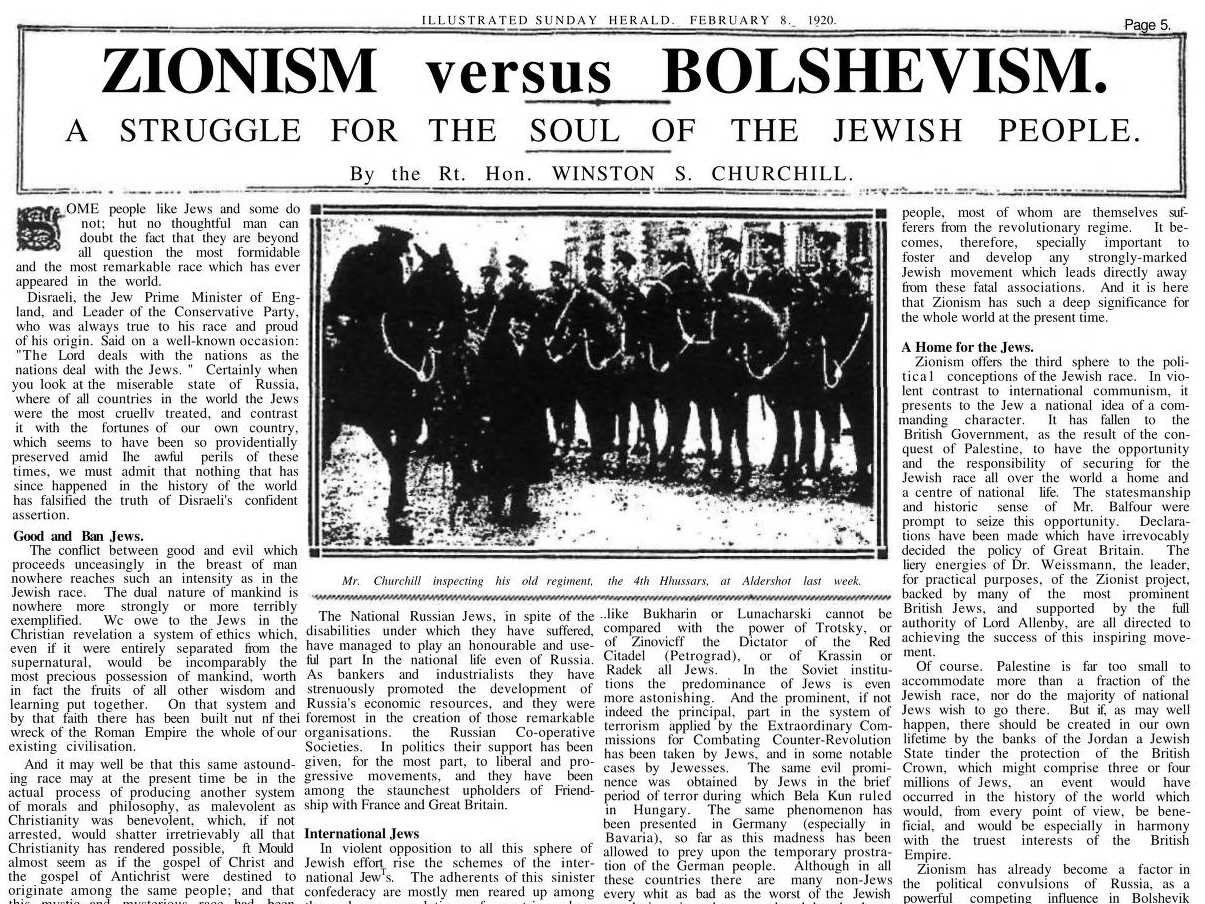
On February 8, 1920, a London newspaper called the Illustrated Sunday Herald published a full-page article by Winston S. Churchill, who was then Britain's Secretary of State for War. The title was "Zionism versus Bolshevism: A Struggle for the Soul of the Jewish People."
Who wrote it matters as much as what it says. This is not a document from an enemy of the Jews. Churchill considered himself a friend and admirer of the Jewish people his whole life, and twenty years later he would lead the war against the most murderous antisemite in history.
That is exactly why the article is worth reading now. It shows, in the words of a famous and friendly statesman, what respectable Europe believed about Jews in the very year Zionism won the backing of a great power.
What the article says
Churchill starts with high praise. The Jews, he writes, are a remarkable race, maybe the most remarkable in the world. Then he explains that there are different kinds of Jews. There are the loyal ones, whom he calls national Jews: patriotic citizens of the countries where they live. There are the Zionists, building a Jewish homeland under British protection, whom he warmly approves of. And there are the ones he calls international Jews, whom the article blames, as a group, for Bolshevism, the communist movement that had just taken power in Russia.
In Churchill's telling, a hidden Jewish revolutionary tradition ran from the French Revolution through Karl Marx down to Trotsky and other radicals of his day, a hundred-year plot against civilization. His source for this was a writer named Nesta Webster, a professional conspiracy theorist whose books belong in the same category as the Protocols of the Elders of Zion, the most infamous antisemitic forgery ever written.
Then the article makes its demand. Jews everywhere, Churchill writes, must publicly fight Bolshevism and by doing so "vindicate the honour of the Jewish name." And it offers its remedy: Zionism. A national home, he says, would steer the energies of the race away from revolution and into something wholesome, a project he considered good for the British Empire as well.
What must be said first
Before looking at how the article thinks, one of its claims has to be dealt with head-on, because it is a lie that has cost Jewish lives. The claim that communism was a "Jewish" project was false in 1920 and is false now. Some individual Jews were indeed prominent among Russia's revolutionaries, individuals fleeing a government that had persecuted them. But Jews were also among the revolution's victims, its opponents, and its refugees, and the traditional religious community hated Bolshevism, which set out to destroy Judaism and largely succeeded wherever it ruled.
Taking the politics of some individuals and turning it into an accusation against an entire people is the basic methodology of antisemitism. In the very years Churchill was writing, that accusation was helping fuel massacres that killed tens of thousands of Jews in Ukraine. Within a generation, it became a central pillar of Nazi propaganda.
That part is obviously false. But what makes Churchill's essay interesting is something else: what its structure reveals about the world that embraced Zionism.
How the article thinks
Look at what the article takes for granted, in its praise and its blame alike. It assumes the Jews are a race with shared tendencies, a single body whose members' actions reflect on everyone. It assumes collective accountability: what revolutionaries do in Moscow imposes an obligation on a tailor in Leeds.
It assumes the Jewish name has one shared honor, which some Jews can stain and other Jews must scrub clean. And it assumes that a Jew redeems himself, and his people, by adopting the correct politics.
"Good Jews" and "bad Jews," sorted by political loyalty, with the grades handed out by the gentile world.
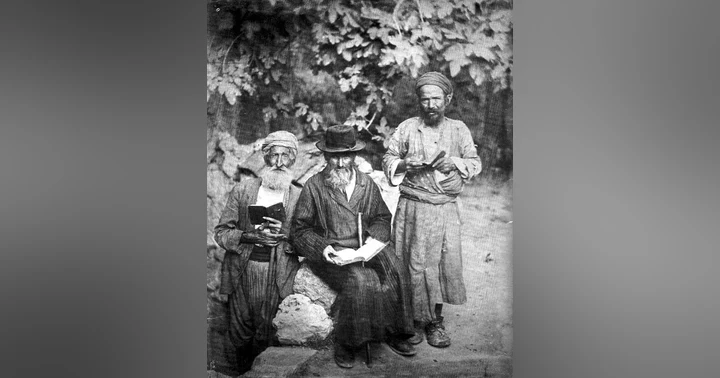
More importantly, notice who is missing. Churchill's list has a box for the loyal patriot, a box for the Zionist pioneer, and a box for the revolutionary. It has no box at all for the Jew as the Torah defines him: the man in Warsaw or Vilna bent over a page of Talmud, a member of no movement, whose Jewishness was a covenant with God rather than politics.
The largest and oldest Jewish self-understanding in the world was invisible to Churchill's system. It always is, in documents like this, because the system is racial and political from the ground up, and the Torah covenant does not fit its boxes.
And inside that false system, Zionism has a precise job. It is the remedy. It takes a people imagined as a restless political race and gives it a channel, an address, a flag, and a sponsor.
Article five of our recent series traced the religious side of gentile support for Zionism, the Protestant idea of the Bible as a land deed. Churchill's essay shows the political side: Zionism as the statesman's answer to what Europe called "the Jewish question," attractive precisely because the statesman had accepted the question's assumptions. The founders of Zionism, as this series has shown, accepted those assumptions too. That was the bargain underneath the Balfour Declaration, Britain's 1917 promise of a Jewish national home, and here it is in the sponsor's own newspaper prose, with conspiracy books in the footnotes.
The sorting never stopped
A century later, the framework is alive and well. It just switches direction. One crowd today grades Jews as good or bad by their support for the State of Israel: the loyal Jew backs the state, and the Jew who criticizes it betrays his people. It is the voice that tells a Jewish student his welcome at the Shabbos table depends on his view of the Gaza war.
Another crowd applies the same test in reverse: the good Jew denounces the state, and the Jew who does not is guilty of its conduct. It is the crowd that demands a Jewish writer denounce Israel before her novel can be reviewed, or that hangs a synagogue's standing on a statement about a war it did not start.
The two camps think they are opposites. They are running the exact operation Churchill ran in 1920. Jews as a political bloc; each Jew answerable for the bloc; honor held in common; standing earned by correct politics, with the grading done by others. And to be clear about what this does and does not claim: criticizing a state is ordinary politics, and any state may be criticized. Grading Jews by their position on it is the operation, whichever position is being demanded.
Jewish tradition's answer to all of it is the one this series gave in its finale. A Jew's identity is a covenant, not a party membership. His obligations are to God and to the people of that covenant, and his moral account is his own. The tailor in Leeds owed nothing for Trotsky, and a Jewish family today owes no one a position on a state as the price of its name.
That answer refuses the sorting when it comes from an enemy, and it must refuse the sorting just as firmly when it comes from a friend, because the friend's version teaches the world the same lesson: that the Jews are one political body whose members can be billed for each other. It was false when it appeared under the byline of the century's most honored statesman, and it has been false in every mouth it has occupied since.
Why They Waited