Who Is a Jew?
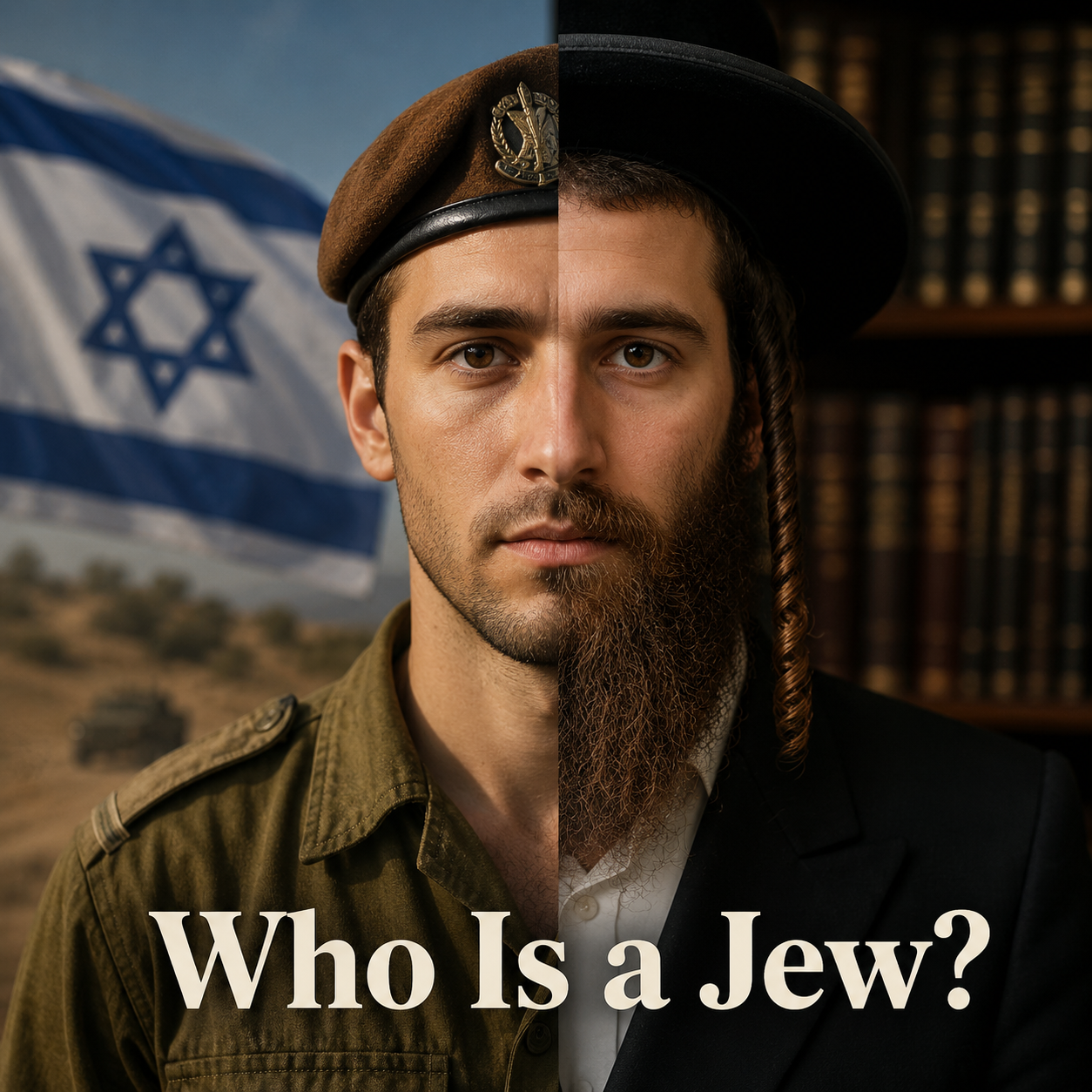
The conclusion of the series on Zionism, Judaism, and why the difference matters. Earlier installments are collected here: Part 1 | Part 2 | Part 3 | Part 4 | Part 5 | Part 6 | Part 7
Every article in this series has circled one question without quite landing on it. The question is the oldest one there is about the Jews: what makes a person one of them? It sounds like a matter for rabbis and philosophers, but it became a matter of statute, because the State of Israel had to write an answer into law. Who qualifies for citizenship as a Jew?
The answer the state settled on repays careful attention. Under Israeli law as interpreted and amended over the years, a person born of a Jewish mother who believes in nothing at all, who has never seen the inside of a synagogue and denies that God exists, is a Jew, entitled to citizenship as one in the State of Israel. A person with the same Jewish mother who has come to believe in another religion is not.
The state's most famous test case involved a man named Oswald Rufeisen, born a Jew, a hero who saved fellow Jews from the Nazis, who later became a Catholic monk known as Brother Daniel. When he sought citizenship as a Jew under the Law of Return, the state refused him. The atheist qualifies automatically; the monk was turned away.
Judged as a religious definition, this is impossible to defend. If Judaism is a faith, then the person furthest from it is the one who denies its God, while the believer in another religion has at least kept the habit of belief. No coherent religious test would rule for the atheist and against the monk. So the definition must not be a religious one, and it isn't. All you have to do is understand what kind of definition it actually is, and the entire subject of this series snaps into focus.
A national definition wearing religious clothes
Think about flags. An American who never flies the flag on the Fourth of July has not betrayed his country; patriotism does not require every observance. But an American who flies a foreign flag on that country's national day has made a statement, and everyone understands it as a statement about loyalty. Skipping your own symbols is tolerable. Adopting the other side's is not.
That is the logic of the Israeli definition, and it is the logic of nationalism everywhere. In the nationalist framework, Judaism is not what makes the Jews a people. The nation is taken as the primary fact, an ethnic body that exists on its own, and the religion is demoted to one of the nation's cultural possessions, a folkway, the tribal costume. On that reading, the atheist has merely declined to wear the costume, which no nation punishes. The monk has put on the costume of another tribe, which every nation punishes. The ruling against Brother Daniel makes perfect sense the moment you see that the law was never measuring distance from God. It was measuring distance from the tribe.
Notice what this does to the traditional order of things. For over three thousand years, the tradition has held that the Torah created the Jewish people: a covenant at Sinai constituted them, and the religion is the reason there is a people at all. The nationalist definition reverses the arrow. The people came first, and somewhere along the way this people happened to produce a religion, as nations produce cuisines and folk dances. Judaism becomes something the Jews made, rather than the thing that made the Jews. This reversal was not an accident of legislative drafting. It is the founding claim of the movement this series has documented, written into the law of the state.
An identity that needs enemies
A national identity of this kind has a structural feature worth understanding, because it explains a great deal of what the world observes. Identity built on peoplehood-without-content is identity by contrast. A tribe knows itself by its rivals; a team means nothing without other teams. Strip away the covenant, and what remains of Jewishness is the boundary itself, the fact of being distinct from others. Such an identity requires the others. It is never fully itself except in opposition.
This is why Zionist identity came to treat antisemitism as its anchor: the Jews are whoever the antisemites persecute, and persecution is what holds the people together. Some Zionist thinking embraced this openly, and the state's political culture still draws on it, finding in each enemy a renewed proof of national purpose.
The Torah's answer could not be more different, and an earlier article put it in a sentence: on the nationalist model, the hater defines the Jew, and on the Torah's model, God does. An identity conferred at Sinai needs no enemy to sustain it. An identity built on exclusion can never safely run out of them.
There was also a darker strand, and honesty requires naming it. Jabotinsky, whose movement governs Israel today, defined Jewishness in the vocabulary of his era's race science, writing of the Jew that "his blood, his body, his physical-racial type are Jewish," and opposing intermarriage as a matter of racial preservation. Whatever else may be said of that definition, it has no source in Judaism. The tradition has welcomed converts for as long as it has existed; the Book of Ruth places a convert in the ancestry of King David himself, and a convert's child is simply a Jew, with nothing to distinguish him.
A religion that anyone on earth may join, and whose royal line descends from a Moabite woman who chose the covenant, cannot be a race and never was one. The racial definition of the Jew was drawn from the nineteenth century, and its principal authors were the antisemites. The nationalists merely ratified it and took pride in it.
The covenant's answer
Against all of this stands the answer the Torah tradition has given since Sinai, and it is worth stating plainly because it is the quiet foundation of every article in this series. A Jew is a member of the people that God brought into covenant: born into its obligations or joined to them by conversion, bound to the Torah whether he honors the bond or neglects it. A Jew who believes nothing remains a Jew in Jewish law, but what he is estranged from is the covenant, not the tribe, and the only way back is through the Torah. Identity of this kind is defined entirely from within. It requires no state, no army, no flag, and no enemy. It survived every empire that held the land of Israel and centuries of exile, carried in books and practice by communities that never commanded a single soldier.
That identity is the one the founders of Zionism inherited and, by their own account, set out to replace. This series has traced the replacement piece by piece: a nation-god borrowed from European romanticism, a character inverted on Nietzsche's instructions, a religion of labor and soil, a land deed borrowed from the church, a sword borrowed from the fascist era, poets singing to Apollo, and finally, in the law examined here, a new definition of the Jew himself: tribal, exclusionary, and racial where the old one was covenantal and open. The project succeeded in building a state. It did not succeed in becoming Judaism, and its own definition of a Jew is the proof.
What to do with all this
The practical conclusions have appeared at the end of every installment, and they belong together at the end of the whole.
A state is answerable for its actions, and may be judged for them like any other state. Jews are not that state. Holding a Jewish family in London or Chicago answerable for a government's conduct repeats the nationalist equation from the hostile side, and it is the engine of most of what is today called antisemitism. Refusing the equation protects them.
The state's claim to speak for the Jewish people should be nothing more than the political claim it is. A movement whose founders rejected Judaism's God, and whose law cannot tell a monk from an atheist, speaks only for its citizens and its believers. It does not speak for a four-thousand-year-old covenant, and the communities most faithful to that covenant have said so from the beginning.
And the word Zionist should be kept honest from both directions. Applied to an ideology and a state, it names nothing more than a political position. Applied to Jews, to a synagogue or a schoolchild, it is the old hatred renting a newer word, and everyone who cares about either truth or Jewish safety should refuse the usage on sight.
The series ends where the tradition stands. There have been many attempts in history to redefine the Jew: by emperors, by churchmen, by race theorists, and, in the century just past, by a nationalist movement drawn from all the sources this series has described. The covenant's answer has outlasted every one of them so far. It is older than the state, it will be there after the state, and it belongs to no government. Anyone who wants to know who the Jews are can still find out the way it has always been done: not by reading a citizenship statute, but by opening the books the Jews have been carrying all along.
It's called the Torah.

The Jewel and the Donkey