The Holy Tongue and the National Language
A visitor who spends one day in an Israeli city and the next in Williamsburg, Brooklyn, or in the most observant neighborhoods of Jerusalem may notice something puzzling. In the Israeli city, everyone speaks Hebrew. It is the language of the street, the newspapers, the army, and the government, and Israelis are proud of having brought an ancient language back to life. In Torah-observant neighborhoods, many of the most religious Jews in the world speak Yiddish or English at home and in the street. They use Hebrew for prayer and study, and many have little interest in speaking it the way Israelis do.
To an outsider, this looks backwards. Shouldn't the most religious Jews be the most attached to the Jewish language?
The answer says a great deal about what makes a Jew a Jew, and about how Zionism changed the question.
A holy language
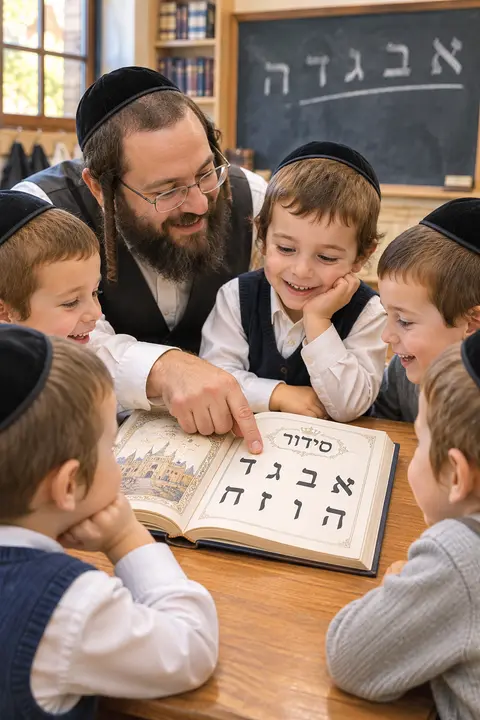
Torah Jews hold Hebrew in the highest regard. They call it lashon hakodesh, the holy tongue. It is the language in which God gave the Torah, the language of the prophets and the Psalms, and the language of nearly every prayer a Jew says each day. Jewish children learn to read it before they learn almost anything else. The medieval sage Maimonides wrote that one sign of its holiness is the purity of its vocabulary, which has no crude words for things people are ashamed to speak of openly.
Hebrew is holy because of what it was used for: the word of God, prayer, and the study of the Torah. Its holiness comes from the Torah.
A people of many languages
Hebrew has never been what makes Jews Jewish.
For most of Jewish history, Jews did not speak Hebrew in daily life. By the time of the Second Temple, many spoke Aramaic, and the Talmud itself, the central work of Jewish law, is written largely in Aramaic. In the Muslim world, Jews spoke Arabic. The great Jewish philosopher Rabbi Saadia Gaon wrote his major work in Arabic, and so did Maimonides with his Guide for the Perplexed. The Jews of Spain and their descendants spoke Ladino. The Jews of Eastern Europe spoke Yiddish, and for centuries the greatest Torah scholars of Poland and Lithuania taught the Talmud in it.
None of these communities was less Jewish for the language it spoke. What bound them together across all those languages was the Torah. Rabbi Saadia Gaon put it in one sentence more than a thousand years ago: "Our nation is a nation only by virtue of its Torah." The Jews are a nation by virtue of the Torah, not by their land, their blood, or their language.
An old teaching holds that while the Jews were slaves in Egypt, they did not change their language, and that this was one of the merits for which they were redeemed. The point of the teaching is that they did not blend into Egyptian society. They kept themselves apart. Jews in exile have done the same in many ways, and in Eastern Europe Yiddish became one of them. It marked a community that lived among other peoples without becoming one of them. Observant Jews who still speak it are continuing that old pattern. Their loyalty is not to a particular language. It is to the Torah, and to remaining a people apart for its sake.
Language as the soul of a nation
Zionism started from the opposite end.
The movement was born in nineteenth-century Europe, when nationalism taught that every nation had its own soul and that a nation's soul lived in its language. Germans were German, in part, because they spoke German, and Italians, Hungarians, and Poles fought to make their languages the languages of their states. The founders of Zionism, most of whom had abandoned the Torah, took that idea and applied it to the Jews. If the Jews were a nation like the others, they needed what the others had: a land, a flag, an army, and a national language.
A. D. Gordon, one of the movement's most influential thinkers, went so far as to write that the nation "created language, religion, morality, poetry, and social life," and that "the nation created man." In that view, language is not a gift for serving God. It is a product of the nation and an expression of its identity, and so is religion.
The early Zionists wanted to make a new kind of Jew, and they gave him a new name as well. Their writers spoke of the "New Hebrew Man," and the movement preferred the word "Hebrew" to the word "Jew." Tel Aviv was called "the first Hebrew city," and the settlers demanded "Hebrew labor." The word "Jew" called to mind the exile and the religion, and the movement wanted to leave both behind. The language was the means of making that change.
The war on Yiddish
Because the national language mattered so much to them, some Zionists treated the languages of the exile as enemies. Activists of Jabotinsky's Betar youth movement, together with a group that called itself the "Battalion of the Defenders of the Language," repeatedly broke up meetings held in Yiddish. They argued that speaking a "Diaspora" language in the Land of Israel profaned Zion. Betar members were also known to beat Jews they caught speaking Yiddish instead of Hebrew.
Yiddish was the language of the Torah world of Eastern Europe: its yeshivas, its rabbis, and its ordinary pious families. The campaign against it was a campaign against the Jewish life of the exile, and against the people who had carried the Torah through it.
A holy tongue put to other uses
There was also a deeper problem, and it explains why many Torah authorities were uneasy about modern spoken Hebrew itself.
To build a modern national language, the Zionists took the words of the Torah and put them to work for a secular state. The language of the prophets became the language of politics, the army, the marketplace, and the newspapers. In one striking case from the 1890s, a Zionist writer introduced Hebrew readers to the philosophy of Friedrich Nietzsche. He translated Nietzsche's "Superman," the man who stands beyond good and evil, as Adam Elyon, the "Supreme Man," using a word the Torah uses as a name for God. The new language could carry ideas the holy tongue had never carried, and many of those ideas were directly opposed to the Torah.
For that reason, a number of leading Torah authorities distinguished between the holy tongue of the Torah and the modern Hebrew of the state, and some of them discouraged their followers from adopting modern Hebrew as their everyday speech. They did not care less about the holy tongue than the Zionists did. They cared about it more, and did not want it turned into a national badge.
What makes a Jew
The difference between the two approaches comes down to a single question: what makes a Jew?
For Zionism, the answer is nationality, and language is one of the marks of a nation, alongside a land and a flag. In that view, a Jew who speaks Hebrew and lives in the Jewish state is more fully a member of the nation than a Jew who speaks Yiddish, English, or French in the exile.
For the Torah, the answer is the covenant with God. A Jew in Brooklyn who speaks only English and Yiddish, but keeps the Torah and prays in the holy tongue three times a day, lacks nothing in his Jewishness. Fluency in modern Hebrew would add nothing to it.
That is why Torah Jews can revere the holy tongue and still feel no particular pull toward the national language of the State of Israel. The holy tongue belongs to the Torah. The national language belongs to a political movement that borrowed the Torah's words to build something the Torah staunchly opposes.
What a Jew Owes