What a Jew Owes

Seventh and final article in the series "Seek the Peace of the City," on what Judaism teaches Jews about the countries they live in. Earlier installments are here: Part 1 | Part 2 | Part 3 | Part 4 | Part 5 | Part 6
This series began with a letter. Twenty-six centuries ago, the prophet Jeremiah wrote to the Jews who had been carried off to Babylon. He told them to build houses, plant gardens, raise families, and "seek the peace of the city." The articles since then have followed that instruction through Jewish law, prayer, conduct, and history. The last article looked at the movement that told Jews the opposite: that they were strangers everywhere but in one country, and that their real loyalty belonged to a state.
That brings the series to the question it has been working toward. If an observant Jew owes no political allegiance to the State of Israel, what does he owe, and to whom? The tradition's answer comes in three parts. It also says something about what he does not owe.
What he owes his country
The first part has been the subject of this whole series. A Jew owes the country where he lives its peace. He is to seek its welfare and pray for it, as Jeremiah instructed. He is to obey its laws, because Jewish law itself holds that the law of the land is the law. He is to pay its taxes honestly, because evading a legitimate tax is a form of theft. He is to deal truthfully with its people, Jews and non-Jews alike. And every Sabbath, in synagogues around the world, he stands while a prayer is said for its government.
The tradition adds one more obligation that is easy to overlook, and that is gratitude. The Torah commands, "You shall not despise an Egyptian, for you were a stranger in his land." Egypt enslaved the Jewish people and drowned their children. Yet because Egypt had once given them a place to live, the Torah requires that the debt be remembered. If a Jew owes that much to Egypt, he owes far more to a country like the United States, which has given Jews freedom, safety, and the right to live by the Torah without fear. Torah leaders of the last century spoke of America with deep thankfulness, and they taught their communities to feel the same.
What he owes other Jews
The second part is the bond among Jews themselves, and here the tradition speaks just as clearly.
The Talmud teaches that "all of Israel are responsible for one another." A Jew is bound to the welfare of other Jews wherever they live. He gives charity to the Jewish poor, in his own city and beyond it. Jewish law counts the ransoming of captives among the greatest of all commandments. When Jews anywhere are in danger, observant Jews pray for them, raise money for them, and do whatever they lawfully can to help.
That includes the Jews of the Holy Land. Observant Jews around the world care deeply about the safety of the Jews who live there, pray for them, and grieve when they are harmed. They also hold the Land of Israel itself to be holy. It is the land God promised, the place Jews face in prayer three times a day, and the land of the redemption to come.
None of this is a political allegiance. The bond among Jews is the bond of a people that shares a covenant with God, and it reaches Jews in Brooklyn, London, and Jerusalem in exactly the same way, without running through any government. A Jew's love for his brothers in the Holy Land is no more a vote for the State of Israel than his love for his brothers in France is a vote for the French Republic. His love for the Holy Land is a religious love, three thousand years older than Zionism. Politically, it asks only that he wait for the redemption God will bring.
What he owes God
The third part comes first in importance, and it gives the other two their shape.
A Jew owes God faithfulness to the Torah: its commandments, its study, and its way of life. He owes God patience. The tradition teaches that God decreed the exile and will end it in His own time, and that the Jewish people are not permitted to end it by force or by politics. While it lasts, a Jew is to live as Jeremiah said, loyal to his country and faithful to his God, and to pray for the day the redemption comes.
The other obligations follow from this one. A Jew seeks the peace of his city because God commanded it through His prophet. He keeps his country's laws because the Torah's own law requires it. He cares for other Jews because they share his covenant. Every one of these duties comes from the same source, and none of them comes from a state.
What he does not owe
It also helps to say plainly what a Jew does not owe.
He does not owe political allegiance to the State of Israel. It is a foreign country, with its own citizens and its own government, and it answers for its own decisions. Calling itself "the Jewish state" does not make it the government of the Jewish people.
He does not owe the State of Israel a defense of its actions, and he does not owe its critics an apology for them. He did not elect its leaders and does not vote in its elections. He is no more responsible for its policies than a Catholic in Chicago is for the government of Italy.
He is not required to hold an opinion on the Israeli-Palestinian conflict at all. Many people, Jews and non-Jews alike, insist that every Jew must take a side. That insistence rests on the Zionist premise that every Jew is a party to the state's affairs. A Jew may pray for peace and grieve for every life that is lost, and still decline to treat a foreign political dispute as part of his religion.
And he does not owe anyone the assumption that his loyalty lies elsewhere. Jewish law teaches him where it lies, and history shows that observant Jews have lived by that teaching.
The peace of the city
Jeremiah gave a reason for his instruction: "Seek the peace of the city where I have caused you to be carried away captive, and pray unto the Lord for it, for in its peace you will have peace."
The prophet did not tell the exiles to love Babylon instead of Jerusalem, or Jerusalem instead of Babylon. He gave each its place. Jerusalem was the city of their prayers and of the redemption to come. The country where they lived was the place to build their lives, keep the law, and seek the welfare of their neighbors until God brought them home. Torah Jews have lived by that letter in every country of their exile, and they live by it today. For them, loyalty to their country and faithfulness to God never competed. It was only Zionism that told them otherwise, that set the two against each other.
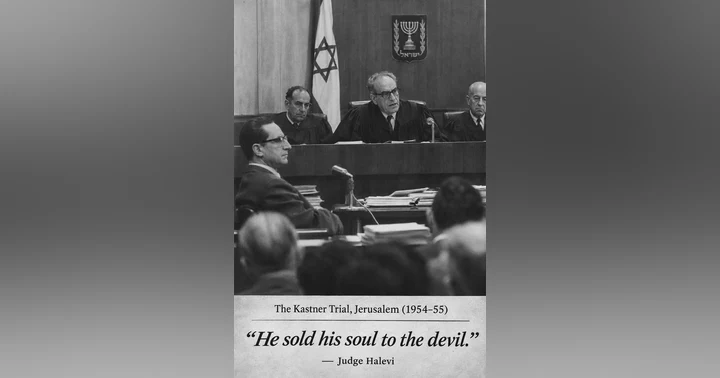
What the Kastner Trial Revealed