The Man Who Asked for a School
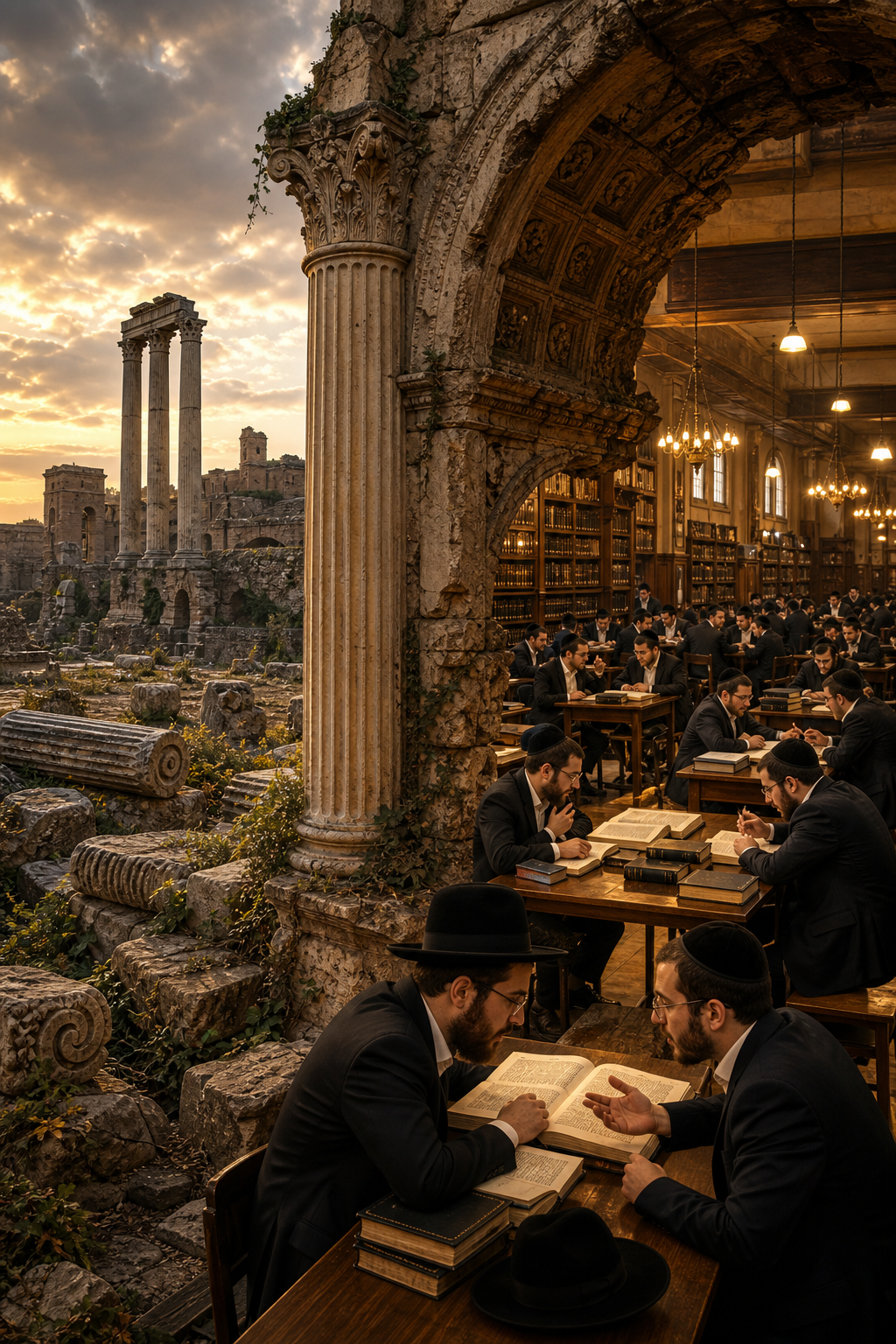
Second in the series "The Two Thousand Year Argument," on what the Jewish people did with exile. Part 1
In the year 70, Jerusalem was surrounded. The Roman army had encircled the city, the siege had gone on for months, and inside the walls the situation was worse than outside them. Armed factions of Jewish rebels had taken control of the city, and in a decision the Talmud records with grief, they burned the storehouses that held Jerusalem's food supply. Their reasoning was that hunger would force the population to fight rather than negotiate. The population starved instead.
The sages of Jerusalem had opposed the war. They had argued against the rebellion, and they were now trapped in a city ruled by the men who started it, watching the end approach.
What one of them did next shaped the next two thousand years.
Out through the gate
Rabban Yochanan ben Zakkai was the leading sage of the generation. He understood that the city would fall and that the Temple would be destroyed, and he understood something else besides: the rebels would not allow anyone to leave. So he feigned death and was carried out of Jerusalem in a coffin.
Outside the walls, he was brought before Vespasian, the Roman general who would shortly become emperor. And Vespasian, in the way of conquerors who are feeling generous, offered to grant him a request.
Think about what a leader in his position might have asked for. Spare the city. Spare the Temple. Spare the priesthood, the treasury, the capital of his people. Rabban Yochanan asked for none of those things.
He asked for Yavneh and its sages: a small coastal town, and permission for the scholars to continue teaching there.
The Talmud records that request matter-of-factly, but Jewish tradition has considered it ever since one of the most consequential decisions in its history. He did not ask for a fortress. He asked for a school.
What he was actually saving
It is tempting for a modern reader to interpret this as a clever pivot, a leader recognizing that the old religion was finished and salvaging what could be repurposed. That reading is wrong, and understanding it correctly is the point of this article.
The Torah, as the previous article explained, was given at Sinai in two parts, the written and the oral, and the oral teaching already contained everything the Jewish people would need for the exile that Scripture itself had foretold. Rabban Yochanan was not inventing a portable Judaism to replace a Temple-based one. He was protecting the transmission of the Torah that the Jewish people already had, in full, including all its instructions for a time without a Temple.
That transmission is the thing Judaism has always guarded most carefully. The tradition opens its most widely studied ethical work by tracing the chain: the Torah was received at Sinai and handed to Joshua, and by Joshua to the elders, and by the elders to the prophets, and onward through the generations, each link receiving and delivering the same inheritance. What lived in Jerusalem was not merely a building. It was the living chain of scholars who carried and taught that inheritance.
Buildings can be rebuilt, and Jewish belief holds that the Temple will be, one day. A broken chain of transmission is a different kind of loss. Rabban Yochanan asked Vespasian for the one thing that could not be replaced, and the Romans, who measured importance in walls and gold, thought they were granting him something small.
What Yavneh did
The scholars gathered in Yavneh, and the high court of Jewish law relocated there and continued its work. Some of the Temple-dependent commandments went dormant, awaiting the Temple's restoration. Everything else continued: the same Sabbath, the same festivals, the same laws of purity and family and commerce, taught and applied exactly as they had been taught and applied in Jerusalem.
There was no revision of Judaism, no council that voted to modernize, no new scripture. The sages of Yavneh made rulings the way the sages had always made rulings, applying the received law to the situation in front of them, using the authority the Torah itself grants for exactly that purpose. Their work was continuation under different conditions, which is why a Jew today can open a page composed in that period and recognize it immediately as his own religion.
And the work traveled. Because what was preserved was a chain of teaching rather than a location, it could be carried anywhere the Jewish people were sent. Within a few centuries the same Torah was being taught in Babylonia, then in North Africa, then in Spain and the Rhineland and Poland. The next article will follow it there.
Two theories, tested
Step back and look at the two responses to Rome that this story contains, because between them they explain a great deal of what this publication writes about.
The rebels held that Jewish survival was a question of force. They had a strategy, they had weapons, and they had enough conviction to burn their own city's food supply to prevent surrender. Within a few years, their strategy produced a destroyed Temple, a ruined city, and enormous loss of life. The Talmud's own account of the catastrophe places responsibility not on Roman strength but on the hatred and division among Jews that made the war possible.
The sages held that Jewish survival was a question of Torah, and that the exile, being a decree from God, would end when God ended it. Their strategy was a school in a coastal town.
Two thousand years later, the results are not in question. The empire that won the war is gone; its language survives only in classrooms and its city is a tourist destination. The school in the coastal town is still running, in Jerusalem and Bnei Brak, in Lakewood and London and Antwerp, teaching the same texts to the descendants of the Jews of that era.
The fox on the mountain
One more scene from the same generation belongs here, because it shows how the sages themselves understood what had happened.
Some years after the destruction, a group of them walked past the ruins of the Temple Mount and saw a fox emerging from the place where the Holy of Holies had stood. Most of them wept. But Rabbi Akiva laughed. When they asked how he could laugh, he explained: the prophets had foretold both the destruction and the rebuilding. Seeing the first prophecy fulfilled so exactly assured him that the second one would be fulfilled just as exactly.
That is not the reasoning of a man improvising after a disaster. It is the reasoning of a man who already knew what the books said, watching the story unfold as written, and settling in for a long wait with his confidence intact.
Thus the era of exile began. What the Jewish people built during it is the subject of the rest of this series.
The Law of the Land Is the Law