The Religion of Labor and Soil
A topical companion to our series on Zionism, Judaism, and why the difference matters. Read the earlier parts here: Part 1 | Part 2 | Part 3
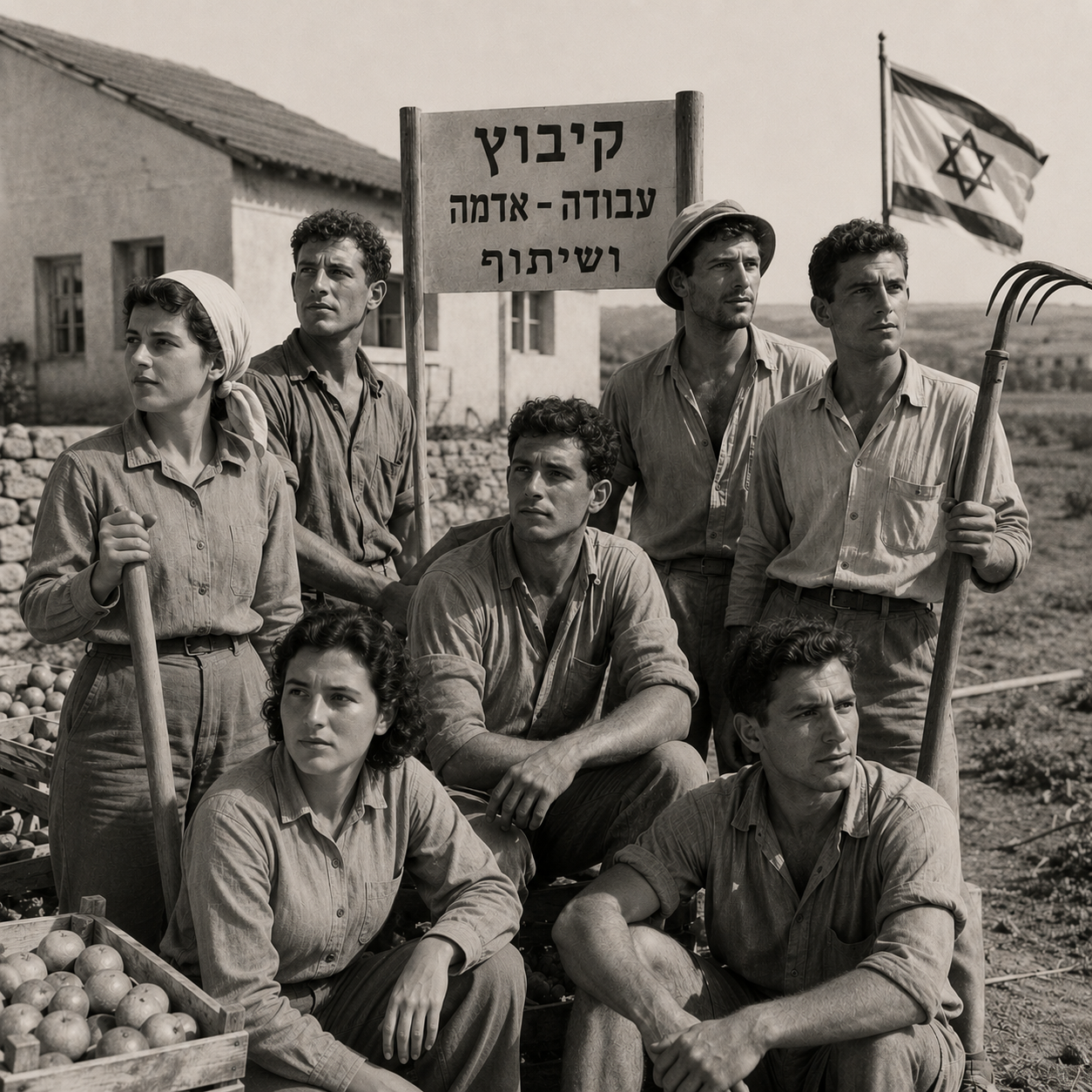
Everyone has seen the pictures, even if they don't remember where. Young pioneers in work shirts, tanned and smiling, draining swamps and planting orange groves. The kibbutz — the communal farm where everything was shared and everyone worked the land. The desert made to bloom. It's the founding legend of Israel, and it's usually told as a religious story: an ancient people returning to its promised land at last.
The people in those pictures would have laughed at that description. Most of them wanted nothing to do with the Jewish religion. Many of them despised it. And yet they worked with a devotion that looks, from any angle, exactly like faith. That's because it was faith — just not the Jewish one. They had built a new religion, and its rituals were plowing, planting, and building. The historians even have a name for it, borrowed from the movement's own philosopher: the religion of labor.
Who the pioneers actually were
First, some numbers that rarely make it into the legend. After the pogroms and upheavals in Russia in the early 1900s, more than a million and a half Jews fled Eastern Europe. Almost all of them went west, mostly to America. Only about thirty-five thousand went to Palestine — and most of those gave up and left within a few years.
The small core that stayed became the founders of the state. They were young, fiercely secular, and steeped in the revolutionary politics of Russia — socialism, Marxism, the worship of "the worker." David Green, who renamed himself Ben-Gurion, came out of this world. So did most of the men and women who built the kibbutz movement. They arrived not as pilgrims coming home to God's land, but as revolutionaries looking for somewhere to build the new society their Russian teachers had dreamed about.
But revolutionaries need something to believe in, and these had left their belief behind.
Listen to their words
The philosopher of the pioneers was a man named A. D. Gordon, who appeared in an earlier article teaching that the nation "created man." Gordon gave the settlers their creed, and he wasn't shy about what kind of creed it was. When someone asked him why Jewish farms should hire Jewish workers even though Arab workers charged less, he didn't answer with economics. He answered by pointing to religion — would a religious Jew break the Sabbath to save money? Of course not, because religion imposes duties that override convenience. The national cause, Gordon said, deserves the same kind of devotion.
Read how the movement talked about itself, and the pattern is everywhere. Gordon's followers declared, "We all direct ourselves to one god. We all want labor and a life of labor." One movement text went further: "The land and only the land shall be the holy of holies for the Hebrew soul." The holy of holies is the innermost chamber of the ancient Temple in Jerusalem, the most sacred place in Judaism — and here it was reassigned to dirt.
Outside observers noticed. A writer named Moshe Calvary looked at the pioneers' life of sacrifice and self-denial in 1915 and asked plainly: "Is this not a religion?" The scholar Joseph Klausner said the pioneers devoted themselves to work "in piety and reverence, as did the Jews of old to Torah and prayer." And at the grand opening of the Hebrew University in 1924, the most celebrated Hebrew poet of the age, Chaim Nachman Bialik, praised the young pioneers for elevating crude physical labor "to the level of supreme holiness, to the status of a religion."
Bialik meant it as a compliment. He was celebrating, in public, at one of their movement's proudest moments, the fact that farming had replaced God.
Fixing the Jews
The pioneers didn't sanctify labor just because they liked farming. They did it because they had accepted, almost word for word, the antisemites' picture of the Jew — the "parasite," the middleman, the peddler who produces nothing. Europe's Jew-haters had been drawing that caricature for centuries. The Labor Zionists agreed with it, and designed their movement to cure it. Gordon wrote that the Jewish people had been "cut off from nature and imprisoned within city walls for two thousand years," that they lacked "the habit of labor," and that only working the soil could make them "normal again."
Normal. It's a word that appears constantly in early Zionist writing, and it always means the same thing: like the other nations. The traditional Jew — the scholar, the merchant, the man of the book — was a deformity to be corrected. If that judgment sounds familiar, it should. It's the same project of inversion described in the last article, wearing overalls instead of quoting Nietzsche.
What Judaism actually says about work
None of this is what work means in Judaism, and the difference is easy to state. Jewish tradition honors labor — the Talmud's sages included blacksmiths and woodchoppers, and supporting one's family is a duty. But work is honorable, not holy. Holiness belongs to God, and a field is just a field. A Jew plants so that he can live, and lives so that he can serve his Creator; the moment the planting itself becomes the object of "piety and reverence," something has gone badly wrong — the structure of worship is intact, but God has been replaced. The rabbis of that generation watched it happen in real time and called it what their tradition has always called such things — idolatry.
The legend and the label
So the next time the founding of Israel is told as a religious homecoming — an ancient faith restored to its land — it's worth remembering what the people who did the founding actually believed. Their devotion was real, their sacrifices were real, and their religion was labor, land, and nation. It was built by people who had walked away from Judaism and weren't shy about saying so. The legend borrows the synagogue's vocabulary, but the pioneers themselves would be the first to tell you: the faith of the kibbutz was not the faith of the Torah, and it was never meant to be.
Next in the series: the strangest borrowing of all — how the idea of the Bible as a land deed came into Zionism not from the synagogue, but from the church.
Quotations from Gordon, Klausner, Calvary, and Bialik are drawn from documentary histories of the Labor Zionist movement, including Civil Religion in Israel and Shmuel Almog's Zionism and Religion*. Full citations available on request.*
The Law of the Land Is the Law