What The Atlantic Conceded
This week The Atlantic published a long essay by Adam Kirsch titled "What Is Zionism?" Kirsch is a thoughtful writer, broadly sympathetic to Israel, and the essay is a serious piece of work. It is also, in its middle section, one of the clearest summaries a mainstream American magazine has ever printed of the case this publication has been making for a long time.
That deserves notice. But so does the place where the essay turns away from its own history.
What the history section says
Kirsch tells the story of Zionism from the beginning, and when he reaches traditional Judaism, he describes it accurately.
He writes that Jewish tradition understood the exile as "a punishment inflicted by God," and that "it followed that only God could decide when the exile would end." He writes that "mainstream Jewish tradition specifically prohibited settling in large numbers in the land of Israel," and that Jews imagined the return as a supernatural event they could not bring about themselves. "All they could do was pray."
He calls Zionism "a product of 19th-century Europe," born from the same soil as socialism and nationalism. He quotes Moses Hess, an early theorist, declaring that "the Jewish religion is, above all, Jewish patriotism," and notes plainly that this idea "broke with traditional Judaism, which defined the Jewish people by its relationship with God." He observes that Herzl, the movement's founder, "knew almost nothing about Judaism," and that the flag Herzl designed for his state contained no Jewish symbols at all.
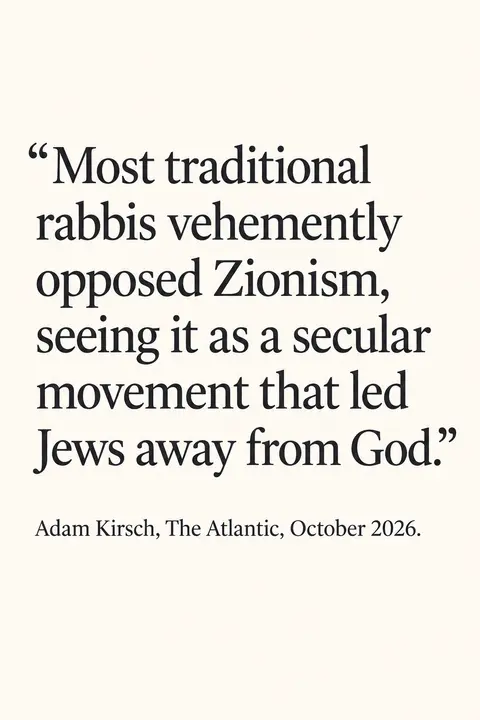
And he states the response of the Torah tradition directly: "Most traditional rabbis vehemently opposed Zionism, seeing it as a secular movement that led Jews away from God. They considered the very idea of settling the land of Israel before the coming of the Messiah to be heretical."
Finally, he sums up the whole relationship in one sentence. Zionism "fulfilled the ancient hope of return, but not in the way Jews had always dreamed of." Instead, "it used politics and diplomacy to create a secular state."
Readers who have followed this publication will recognize every point. The exile as a divine decree, the end of the exile as God's act alone, the European origins of the movement, the secularism of its founders, and the rabbis' rejection of it. None of this is an obscure claim from a fringe community. It is the historical record, and here it appears in The Atlantic, written by a friend of the State of Israel.
Where the essay is right about the present
Kirsch also devotes a good part of his essay to what has happened to the word "Zionist" in public life, and much of what he documents is ugly and real. A political candidate who proposed imprisoning "American Zionists" and castrating them. The use of "Zio," a slur popularized by white supremacists, in ordinary conversation. A widely shared post claiming that "Zionist tunnels" had been found under New York synagogues, with mattresses and children's high chairs inside, which is the medieval blood libel almost word for word. Attacks on synagogues and on Jewish gatherings.
On all of this, there is no disagreement. When "Zionist" is used as a code word for "Jew," and aimed at synagogues and Jewish families who govern no country and command no army, it is antisemitism, and it should be named that way every time. This publication has said so repeatedly, and it is worth saying again here, without qualification.
Where the argument turns
The difficulty comes when Kirsch moves from the abuse of the word to a definition of the position itself.
He compares modern anti-Zionism to the original antisemitic movement of nineteenth-century Germany, which called itself opposition to "Semitism" as though it were fighting an idea. "Today," he writes, "anti-Zionism follows a similar logic. Opposition to an ism cloaks a desire to exile or kill the millions of Jews living in Israel."
Now place that sentence beside his own history section. The traditional rabbis he described a few pages earlier opposed Zionism. They opposed it vehemently, and on religious grounds. If opposition to Zionism is a cloak for the desire to kill Jews, then those rabbis stand accused, and so do their students and communities, who hold the same position today. A definition that convicts the authorities of the Jewish religion of wishing harm on Jews cannot be correct. It is the very equation Kirsch himself criticized when antisemites used it, simply flipped around.
There is a reason the definition sounds plausible in his essay, and it is a matter of who appears in it. Religious Jews are present in the history and absent from the present. Every contemporary opponent of Zionism Kirsch names is a progressive activist, a right-wing pundit, or a Palestinian writer. The largest organized Jewish communities that reject Zionism, in Jerusalem and in Brooklyn, the direct continuation of the rabbis he quoted, never appear. Once they are left out, it becomes easy to describe anti-Zionism as a hatred aimed at Jews. Once they are included, that description falls apart.
The question Kirsch asks
Kirsch puts a pointed question to anyone who calls for the end of the State of Israel. What, concretely, would happen to the roughly seven million Jews who live there? It is a fair question to ask of political activists who demand a particular outcome by a particular date. It deserves a direct answer from this publication as well, because the answer shows how different the Torah position is from the movements he describes.
The Torah position is not a political program, and it has never claimed to be one. It holds that the founding of a state to end the exile by human means was and is a rebellion against the teaching that only God ends it. That is a statement about what the Jewish religion permits and forbids. It is not a plan for dismantling a country, and it does not call on anyone to bring about any outcome by force. The response it does prescribe is prayer: that God resolve the situation His people are in, in His way, without harm to any Jew.
Nor does this tradition owe a political blueprint for a problem it warned against and had no part in creating. The founders of the state were told, in writing and at the time, that their project contradicted the Torah. They went ahead. Those who chose to build it are the ones responsible for what it has produced, and asking the tradition that opposed them to supply the solution gets the order of responsibility backward.
One thing, though, can be said with confidence, because it would help immediately and harm no one. Much of the danger Kirsch documents comes from a single claim, the state's description of itself as "the Jewish state," speaking and acting in the name of the Jewish people as a whole. That claim is exactly what allows an angry person in Michigan or London to treat a synagogue as an embassy and a Jewish child as a combatant. A state that described itself as a state, answerable for its own decisions, and stopped presenting itself as the representative of every Jew on earth, would remove a great deal of fuel from the fire Kirsch rightly fears.
What the essay admits at the end
Kirsch closes with an admission that deserves to be taken seriously. Zionism promised to make the Jews a "normal" people. Herzl predicted that Jews settled in their own state "would probably have no more enemies." Kirsch concedes that this has not happened, that the hatred he documents is the clearest sign of Zionism's failure on its own terms, and that "individual Jews can't dissociate themselves from the status and fate of the Jews as a whole."
That last sentence is where the deepest disagreement lies. Kirsch treats the equation of Jews with the state as a fact Jews must accept. The Torah tradition treats it as precisely the mistake that has made Jews less safe, and the history he tells explains why. The rabbis who opposed Zionism did not predict a "normal" people living without enemies. They predicted that tying the Jewish people to a political project would bring the consequences of that project onto every Jew, everywhere. Kirsch's own essay, with its list of attacks on Jews who have no connection to any government, reads like a confirmation of their warning.
His history section was right. The tradition he described there is still here, and it still says the same thing it always has.
The Story That Replaced the Story