What the Rabbis Said While It Was Happening
Second in the series "The Kippah and the Flag," on religious Zionism and how it fits, or does not fit, into the Jewish religion. Part 1 is here.
When religious Zionism appeared a century ago, the leading Torah authorities of the era saw it while it was happening and passed their verdicts. Let's examine them.
One ground rule first, so the testimony can be weighed properly. "Authority" in the Torah world is not a title anyone can claim. It describes the select Torah scholars in each generation whose mastery of Jewish law is so widely recognized that observant communities across the world submit their hardest questions to them. Their names are attached to the standard legal works that religious Jews study to this day. These are the witnesses about to testify, and in the Jewish world, there are no higher ones.
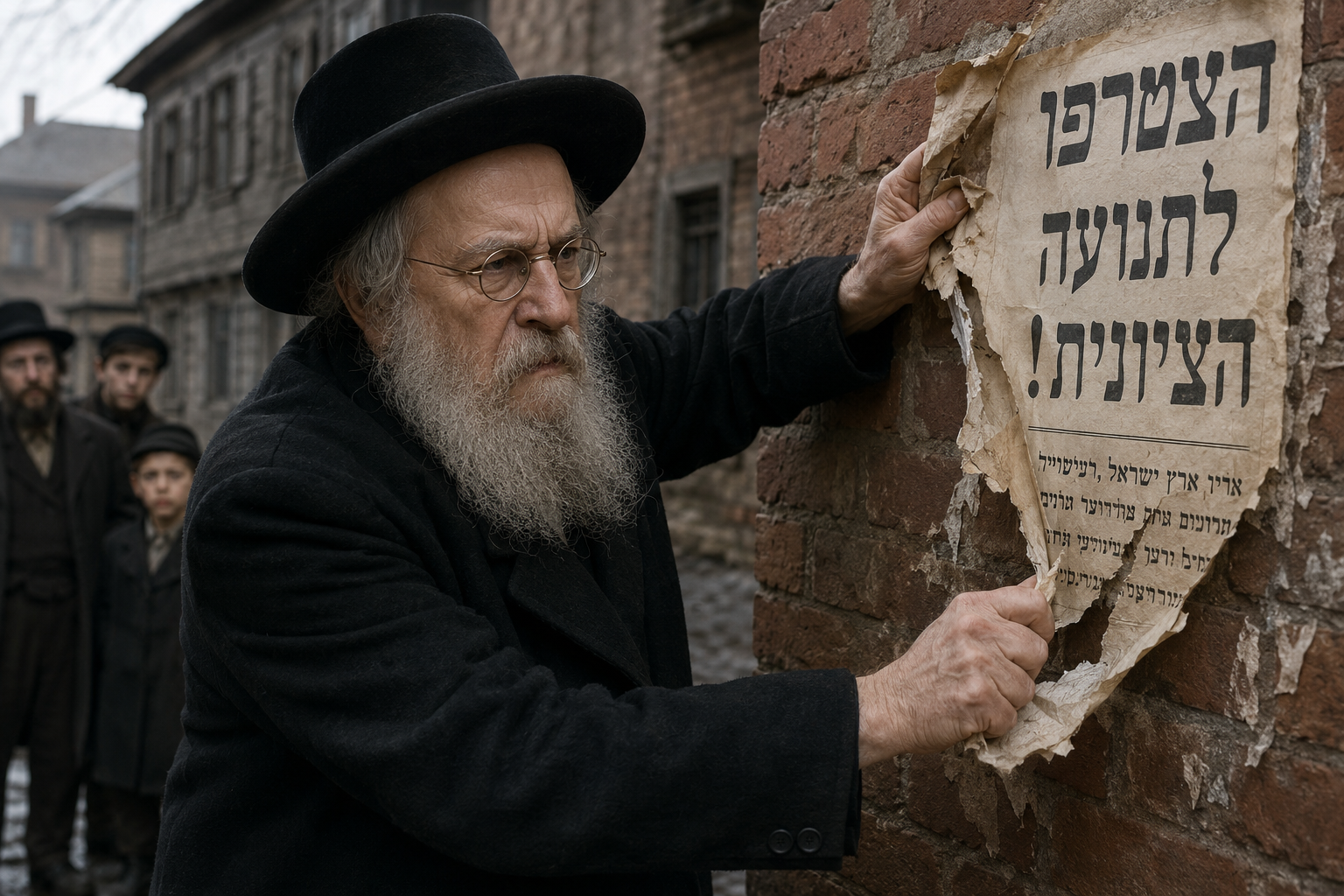
A poster in Vilna
Start with a scene. In the 1930s, Rabbi Avraham Yeshaya Karelitz, known by the title of his masterwork as the Chazon Ish, saw a poster in Vilna advertising the opening of a new "Religious Zionist" school. He ripped the poster from the wall and tore it to shreds in front of his students. Then he explained himself. The very name "religious nationalist," he told them, announces the problem: it "expresses a need to add to religion," declaring that the nationhood of the Jewish people is something other than their religion, and it thereby departs from the faith itself.
His objection was not about politics, or a quarrel about borders or governments. It was to the claim, built into the movement's own name, that Jewishness has a national component separate from the Torah, onto which the Torah can then be attached. That, the Chazon Ish said, is a different religion, not Judaism.
Note that the Chazon Ish soon after settled in the Land of Israel, in Bnei Brak, where he lived out his life and became the most sought-after authority of Torah law in the country. His opposition was never to the land, which Jewish law cherishes, or to Jews living in it, which he himself did. It was to the false ideology.
A verdict in writing
The scene in Vilna had a written counterpart. Rabbi Elchonon Wasserman headed the great yeshiva of Baranovich and was the closest disciple of the Chofetz Chaim, the sage revered across the entire Jewish world as the early twentieth century's saintliest figure. In his essays on the crisis of the era, Rabbi Wasserman ruled on the new movement in a single line: nationalism, he wrote, was an alien creed, and religious nationalism was the same alien creed with the Name of Heaven attached. Attaching God's name to it, in other words, did not fix the problem. It compounded it.
Rabbi Wasserman was murdered by the Nazis in 1941, together with his students. He is honored today across the observant world as a martyr, and his essays from those years are studied as classics. This is not a marginal voice recovered for polemical convenience. This is the mainstream of the mainstream, in print.
The same verdict came from Jerusalem. Rabbi Yitzchok Zev Soloveitchik, known as the Brisker Rav, heir to the most celebrated dynasty of Talmudic analysis in the modern era, refused to grade the religious version of Zionism above the secular one. Pressed on the two camps, his answer was that at the root they were making the same error, one in observant dress and one without it. The dress, for him, changed nothing about the ideology underneath.
The honest count
There was another side, though, and we will not hide it. A faction of rabbis founded the religious Zionist movement, Mizrachi, at the start of the twentieth century. Article four of this series will examine its ideas and follow where they led.
But the weight of the era's recognized authorities is not a close question. Across every region and school of the observant world, Lithuanian yeshiva heads, Chassidic masters in Poland and Hungary, the great communities of Germany, the leadership lined up on one side. When the observant world built its international communal organization, Agudath Israel, in 1912, a driving purpose was precisely to stand apart from the nationalist movement and its religious wing.
The average reader of the news has never heard any of this, which says something about the media. It says nothing about the record.
Testimony from inside the house
Perhaps the most striking document, though, comes from the religious Zionist camp, decades later, in America.
Rabbi Joseph B. Soloveitchik of Boston, a nephew of the Brisker Rav, became the leading authority of American religious Zionism, the teacher of generations of its rabbis. No figure carried more weight inside the movement in the second half of the twentieth century. Yet late in life, reflecting on what had become of his community, he said this: "Emotionally, I feel Zionism — religious Zionism — has replaced Torah."
Fairness requires the context, and the context sharpens the point rather than softening it. The publisher of the talks in which the remark was recorded explains that Rabbi Soloveitchik said it in sorrow, as a criticism: religious Zionism had made Zionism the focus of religion, when Torah is its true and only focus, and living in the Land of Israel, however important, is one commandment among many.
He was not renouncing his movement. He was testifying, from its highest bench, that the alien graft had grown in exactly the direction the European authorities had warned about. The nationalism was no longer an addition to the faith of his community. In its heart, it had become the faith, and the man who led the movement in America said so out loud.
What the record establishes
Put the documents side by side and the shape of the answer from article one fills in. A century ago, the recognized authorities of the Jewish religion examined religious Zionism at its birth and identified it, in writing, as a foreign graft. A minority faction proceeded anyway. A century of atmosphere did the rest, carrying the sentiment far beyond the faction, to multitudes of sincere Jews who never saw these documents and were never told they existed. The world's cameras then photographed the result and captioned it "Judaism."
The record cannot be manufactured after the fact, and it wasn't. It was written while the cement was still wet, by the men whose job it was to know. The next article looks at what they were warning about, up close: the flag beside the holy ark, a state's independence day inside the prayer book, and the simple test that tells an import from a commandment.
Why They Waited