Why Israel's Battle Over Drafting Religious Students Is About More Than Military Service
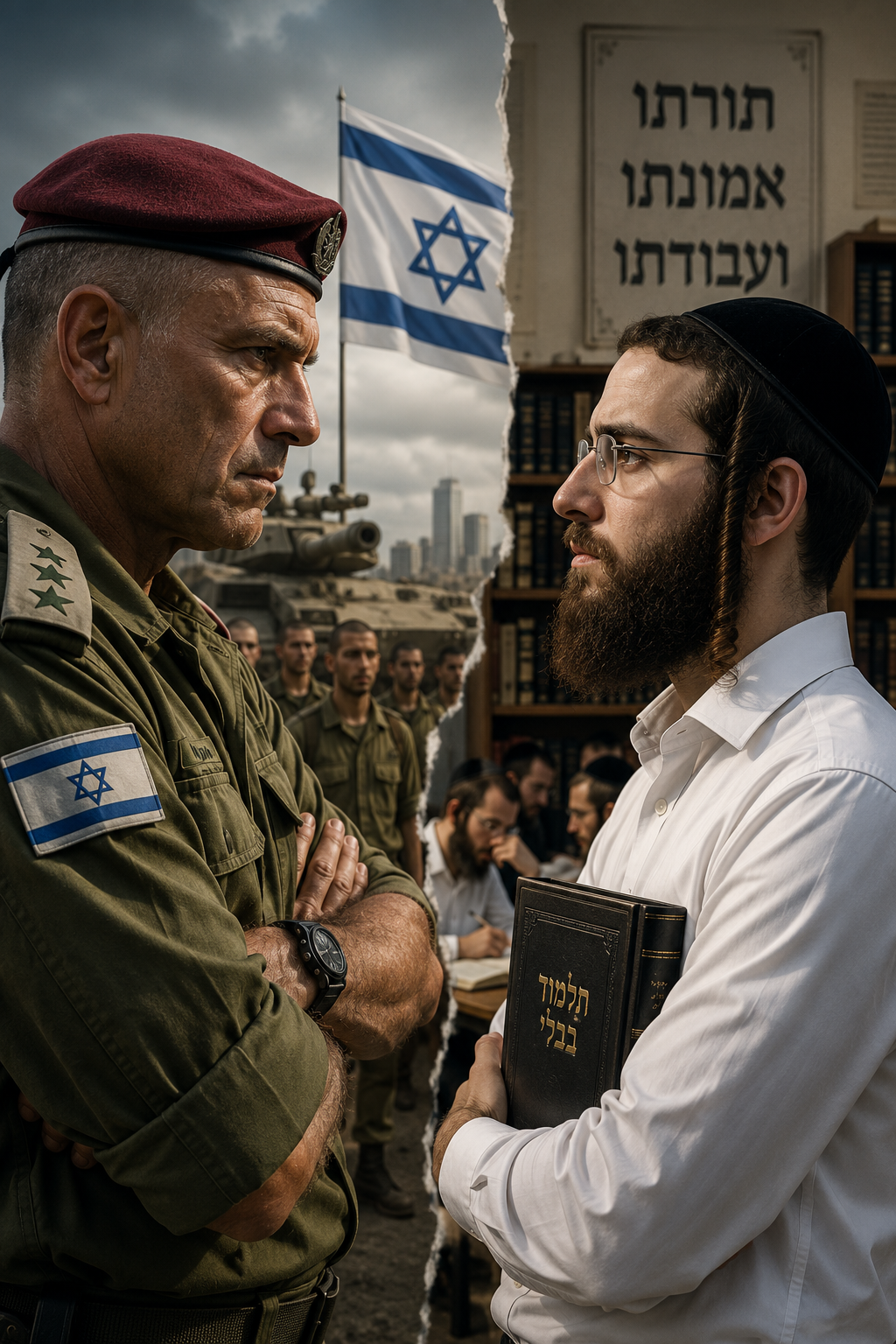
When most outsiders hear about Israel's effort to draft ultra-Orthodox Jewish students into the military, they assume the dispute is about fairness.
Israel faces security threats. Most young Israelis serve in the military. Many religious students do not. Therefore, the argument appears straightforward: Should everyone share the burden equally?
But for many traditional Orthodox Jews, the issue is not primarily military at all. They view the draft controversy as the latest chapter in a much older struggle over Jewish identity itself.
To understand why, one must understand a central tension that has existed since the birth of the Zionist movement.
Judaism has always defined Jewish identity as a religious covenant. Jews are a faith community bound by divine law. They have lived in many countries, speak many languages, and belong politically to the nations in which they reside.
The founders of political Zionism sought something different. They wanted to transform the Jews from a religious community into a modern nation like other nations. They sought not merely to protect Jews, but to create a "new Jew": physically strong, self-reliant, nationalist, and connected to a sovereign state.
This goal was not hidden. Early Zionist leaders openly spoke about creating a new national identity that would replace what they saw as the weaknesses of Jewish life in exile.
No institution was more important to this project than the Israeli army.
Most countries view their military as a tool of national defense. Israel's founders often described the military as something more. David Ben-Gurion, Israel's first prime minister, repeatedly referred to the army as a national melting pot whose purpose was to forge a new Israeli identity out of diverse immigrant populations. The military was expected not only to defend the state but also to reshape the people.
This helps explain something that often puzzles outside observers.
If the debate were only about military manpower, the emotional intensity surrounding religious exemptions would be difficult to understand. Israel has long exempted other groups from service. Various categories of citizens have avoided military duty for different reasons throughout the country's history.
Yet the question of yeshiva students consistently generates extraordinary political passion.
Why?
Because Zionists see military service as more than a civic obligation. It is viewed as a rite of national belonging.
The army teaches a particular story about Jewish history: that centuries of Jewish vulnerability culminated in the creation of a sovereign Jewish state and a powerful Jewish military. In this narrative, the Israeli soldier becomes the symbol of Jewish renewal and redemption. The army is not merely defending Israel. It is reversing centuries of Jewish weakness.
For secular Zionists, military service often functions as a central expression of national identity. For religious Zionists, it can take on even deeper significance, sometimes being portrayed as participation in a historic or even sacred mission.
Traditional Orthodox Jews see this very differently.
They argue that the military is not a neutral institution. In their view, it promotes a false ideology about Jewish identity, Jewish history, and the role of the State of Israel—one that is antithetical to their religious beliefs. They know that service in the army is designed to cultivate loyalty not merely to the state but to a broader Zionist worldview.
Orthodox Jews have long objected to the military's social environment as well. They point to mixed-gender settings, secular cultural influences, and educational programs that present interpretations of Judaism fundamentally different from traditional religious teachings. For them, military service represents a powerful assimilating force.
That is why religious Jews do not see the draft issue as a question of sharing civic responsibilities. They see it as a religious struggle.
From their perspective, forcing yeshiva students into military service would not simply require them to wear a uniform. It would subject them to a state institution whose explicit historical mission has been to reshape Jewish identity.
The irony is that Zionists and anti-Zionist Orthodox Jews often agree on one point: the army changes people.
Supporters view that transformation positively. They believe military service creates social cohesion, national solidarity, and a shared Israeli identity.
Opponents fear precisely those same outcomes.
They believe that the military's success at creating a unified Israeli identity comes at the expense of their religious commitments and distinct religious communities.
This helps explain why the conflict has persisted for decades and why compromise has proven so difficult. The two sides are not merely arguing about military service. They are operating from radically different understandings of what the Jewish people are.
One side sees the army as a cornerstone of national renewal.
The other sees it as a vehicle for cultural and religious transformation.
As a result, every draft proposal becomes more than a policy dispute. It becomes a symbolic battle over competing visions of Jewish identity.
To many outside observers, the controversy appears to be about exemptions.
To many of the people involved, it is about something much larger: whether the State of Israel has the right to define what it means to be Jewish.
That question has been at the heart of the Zionist debate for more than a century.
The current draft crisis is not creating that conflict.
It is revealing it.

Why They Waited