The Flag Beside the Ark
Third in the series "The Kippah and the Flag," on religious Zionism and how it fits, or does not fit, into the Jewish religion. Earlier installments are here: Part 1 | Part 2
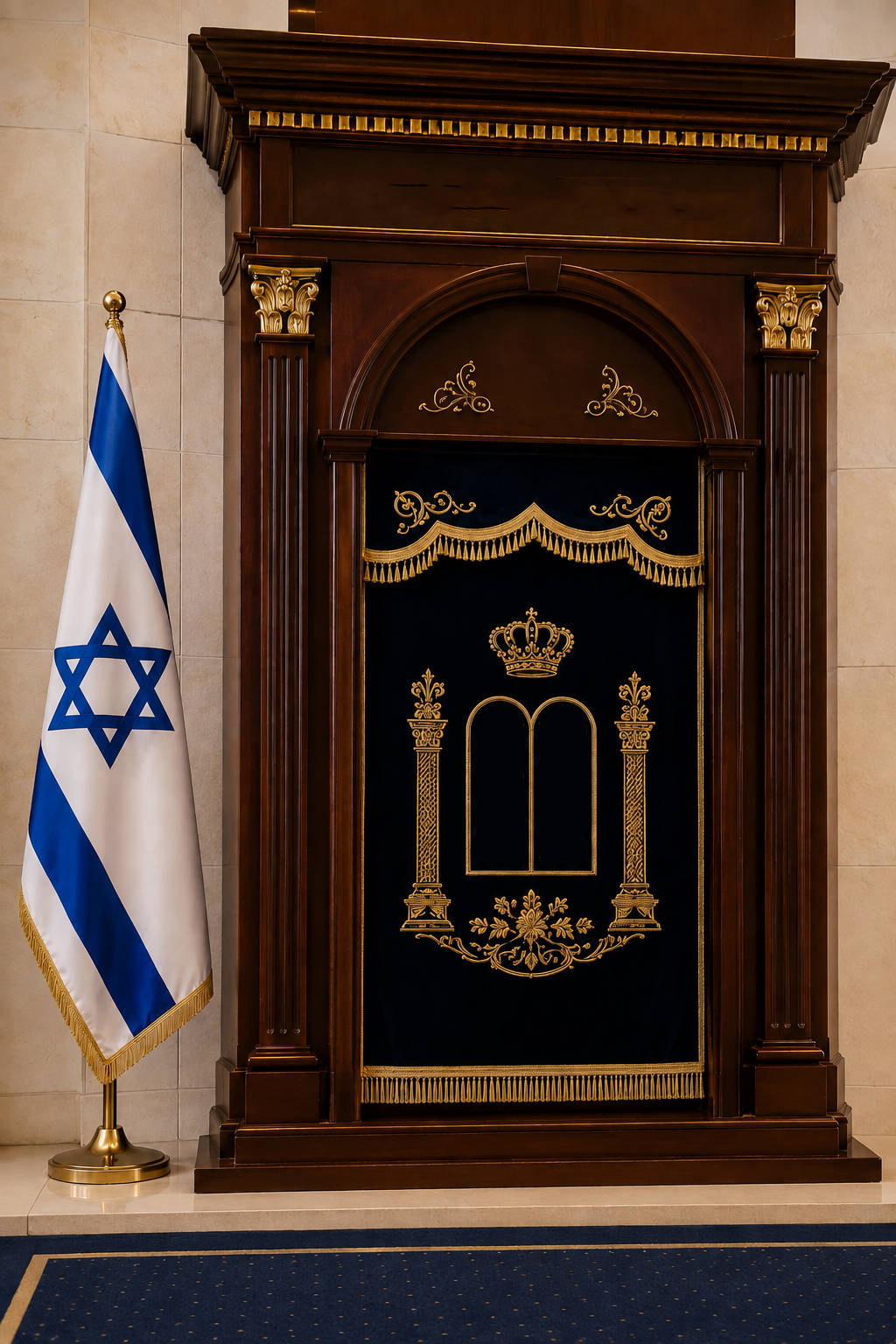
Walk into many Modern Orthodox synagogues in America and you will see, at the front of the room, the holy ark: the ornamented cabinet holding the Torah scrolls, the most sacred objects in Jewish life. Congregants face it to pray. And standing beside it, in synagogue after synagogue, is the flag of the State of Israel.
A visitor could be forgiven for assuming the arrangement is ancient, or at least natural, as if the faith and the flag had always gone together. The previous article showed what the era's leading Torah authorities said when this combination of faith and nationalism first appeared. This article looks at the arrangement itself, up close, and applies the one test that Judaism itself insists on.
The test
Judaism is a religion of law. Every practice in it has a category and a source: a commandment from the Torah, an enactment of the rabbis, a custom with a documented history. Observant Jews live by these distinctions daily, and the movement this series is describing prides itself, by its own account, on rigor about them. So the test is the tradition's own, and it is simple. For each new practice, ask: is this a commandment or an import? Where does it come from, and what does a Jew violate who declines it?
Let's apply it to what the visitor sees.
The flag
Start with the flag beside the ark. There is no source for it. No commandment, no rabbinic enactment, no custom older than the state itself. A national flag standing beside a tradition's holiest object is not a Jewish practice with a pedigree; it is what nations do, transplanted into a sanctuary.
Readers from church backgrounds may find this debate familiar. Some congregations place the national flag in the sanctuary, and members have argued for generations about whether it belongs near the altar, about what it says when the symbol of a state stands inside the worship of God. Judaism's version of the question is sharper still, because the flag in the synagogue is not the flag of the congregants' own country. American Modern Orthodox Jews pray beside the banner of a foreign state, positioned next to the Torah, and the arrangement is treated as though it were part of the religion. On the test, it fails at the first question. It is an import, and a recent one.
The calendar
Next, the prayer book. In religious Zionist congregations, Israeli Independence Day is marked as a religious occasion, in many communities with the recitation of Hallel, the sequence of psalms the tradition reserves for divinely ordained festivals like Passover. This is a larger step than an outsider might realize. The Jewish liturgy is ancient and fiercely guarded; the calendar of the year is fixed by law and centuries of practice. Adding a modern state's independence day to that calendar, with the liturgy of a festival, is a change of a kind the tradition never permits, made on behalf of a political event. Among American religious Zionists, the day is often celebrated with more festivity than their own country's Fourth of July.
Again the test: which commandment, whose enactment, what custom? The honest answer is that the practice was created after 1948, by the movement, for the state.
The report card
Third, the schools. Many Modern Orthodox day schools publish their core values, and a standard formula runs: love of God, love of the Jewish people, love of the Land of Israel. Some add a fourth in plain words: love of the State of Israel.
Now, loving the Land of Israel is a fine thing. The land is holy in Jewish law, and Jews have cherished it for three thousand years. But notice what the formula does. It ranks that love as a core value of Jewish education, listed in series with the love of God, which is an explicit commandment of the Torah. So ask the school's own question back to it: in what category is this? What does a child violate who lacks it? The tradition's answer, cited in the previous article from the Brisker dynasty itself, is that the land is one commandment among the commandments, distinguished and precious, as the Sabbath is precious, as circumcision is precious. Nothing in the Torah makes it the organizing center of a Jewish identity. Something else does that: nationalism, for which a homeland is the organizing center of every identity. A school that ranks love of the land alongside love of God is teaching its students nationalism and calling it Judaism.
The kiss
One last item, a small story reported by a rabbi of the anti-Zionist tradition from his own conversation. A religious Zionist colleague described landing in Israel and kissing the ground, a gesture of love for the holy land. The first rabbi asked him: parts of Lebanon fall within the boundaries of the biblical Land of Israel; had his plane landed there, would he have kissed that ground? No, the colleague answered; land in gentile hands is nothing to celebrate. Would he decline to kiss a Torah scroll owned by a gentile? Would he have kissed this same ground in 1947?
The questions answer themselves, and they are not a trap; they are a diagnosis. The gesture was sincere. But what the lips were honoring was not the holy land, which was equally holy in 1947 and is equally holy across the Lebanese border. It was the state. The feeling is real, and it has been quietly transferred from the one to the other, so quietly that the man himself never noticed the exchange.
The transfer, named
The exchange over the kiss is a small example of a much larger transfer, one that runs in both directions. Secular Zionism took the Jewish people's ancient feeling for the Land of Israel and redirected it toward the State of Israel; that was deliberate, and this publication's first series documented it. Religious Zionism inherited the redirection and completed the circuit: religious honor flowed to the state, which is how a flag reached the ark and a political anniversary entered the liturgy, and national centrality flowed to the land, which is how one commandment among many became the declared core of a child's Jewish identity.
Every item on the visitor's tour fails the same test the same way. Not one of them is a commandment. All of them are imports, less than a century old, from the ideology whose birth records the previous articles opened. The sincerity of the people practicing them is exactly as real as it looks, which is what the first article promised to keep saying. But sincerity tells you about the people. The test tells you about the practice.
The next article asks the deeper question underneath all of it: what doctrine could convince observant Jews that a secular state belongs inside their religion at all? The answer involves the end of the world, and it is the strangest chapter in this story.

Why They Waited