The Golden Ages
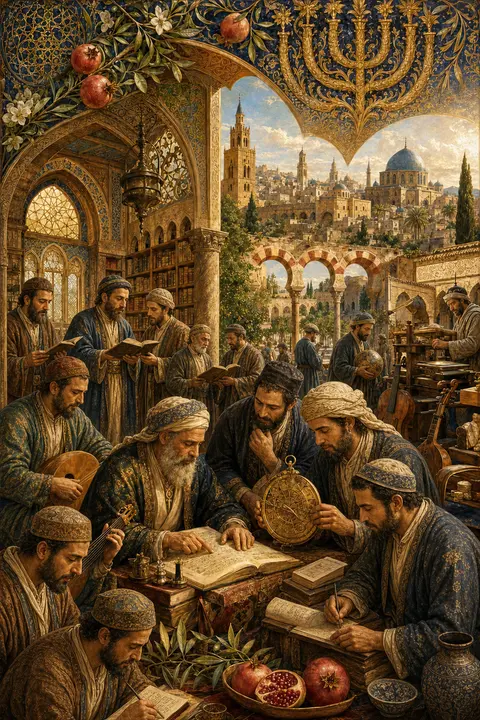
Fourth in the series "The Two Thousand Year Argument," on what the Jewish people did with exile. Earlier installments are here: Part 1 | Part 2 | Part 3
The popular picture of Jewish history between Rome and the modern era is a picture of victims. Expulsions, massacres, ghettos, and yellow badges, one persecution after another, with nothing in between but waiting.
The persecutions were real. But a history told only as a list of injuries leaves out the more remarkable fact, which is what the Jewish people were doing in the same centuries, often in the same decades, sometimes in the same year as the disasters. They were producing some of the finest intellectual work of the medieval world, and they were doing it as a minority with no country of its own.
Here are three of the places where it happened.
Babylonia
For roughly five hundred years, the center of Jewish learning was in what is now Iraq. Two academies, at Sura and Pumbedisa, had operated since the Talmudic period, and from about the seventh century their heads became the recognized authorities of the entire Jewish world.
Their reach was extraordinary for the era. Questions came to them from North Africa, from Spain, from Egypt, from Persia and beyond, and the answers went back along the same trade routes. The head of one of these academies in the tenth century, Rav Saadia Gaon, wrote works of Jewish philosophy, compiled a prayer book, produced pioneering work on Hebrew grammar, and translated the Torah into Arabic so that Jews living in Arabic-speaking lands could study it in the language they actually spoke. He did all of this while running an academy and answering legal questions from three continents.
This was not the work of a people in hiding. It was that of a people with an assignment, carried out in the middle of somebody else's empire.
Spain
Beginning around the tenth century, and lasting in various forms for several hundred years, the Jewish communities of Spain produced a body of work whose quality is still difficult to believe.
Shlomo ibn Gabirol wrote philosophy that Christian scholastics studied for centuries, sometimes without realizing the author was Jewish, alongside religious poetry that entered prayer books and is recited to this day. Yehuda HaLevi wrote poetry of such power that it is still taught in literature courses, and a philosophical work defending the Jewish faith that remains in print nine hundred years later. Avraham ibn Ezra wrote commentaries on Scripture that appear in standard editions today, and made contributions to mathematics and astronomy along the way.
And then there is Maimonides, born in Córdoba in the twelfth century, known in Jewish life by the initials of his name, the Rambam. He wrote a complete and systematic code of the entire body of Jewish law, a work of such organization and clarity that no one before him had attempted anything like it, and he wrote a major work of philosophy besides. He served as physician to the court of the ruler of Egypt. He answered legal questions arriving from Yemen and from southern France.
And consider the detail that the popular picture leaves out. Maimonides did not do this work in comfort. His family fled Córdoba when he was a boy, driven out by a fanatical regime that gave Jews the choice of conversion or exile. They moved through Spain, then to Morocco, then to the Land of Israel, and finally to Egypt. He wrote his greatest works as a refugee and an immigrant, in a country not his own, while supporting his household as a working physician.
That is the pattern: Disaster and achievement are not two separate stories. They are the same story, and the achievement usually came second.
Ashkenaz and Poland
The third center grew up in Christian Europe, in the Rhineland and northern France, and later moved east into Poland and Lithuania.
Rabbeinu Gershom, around the year 1000, headed an academy in Mainz and issued rulings that shaped Jewish family life across Europe for the next thousand years. A generation later, Rashi of Troyes wrote commentaries on the Bible and the Talmud that are so essential that they have been printed alongside the text on nearly every page of nearly every edition ever since. A Jewish child beginning Talmud study today, anywhere in the world, meets Rashi in the first week. His grandsons and their students, the Tosafists, produced a body of analysis that transformed how the Talmud is studied and is printed on the facing side of the same page.
The Rhineland communities that produced this work were devastated by the Crusader massacres of 1096. The survivors rebuilt. The academies continued, then moved east as conditions worsened, and by the sixteenth century Poland and Lithuania held the largest concentration of Jewish learning in the world, with a network of yeshivos and a remarkable self-governing body, the Council of Four Lands, coordinating Jewish communal life across a vast territory for nearly two centuries.
Then came the massacres of 1648 and 1649, which destroyed hundreds of communities and killed a substantial portion of Polish Jewry. And in the generations that followed, that same shattered community produced some of the most important works of Jewish law and thought of the modern era, and the movements and academies whose descendants fill study halls today.
What the pattern shows
Set the three centers side by side, and the shape is unmistakable — it is not victimhood.
Every one of these communities was eventually expelled, massacred, or both. Spain expelled its Jews in 1492, ending the golden age described above. The Rhineland communities were destroyed and rebuilt more than once. Polish Jewry was devastated in the seventeenth century and again, on an incomparably greater scale, in the twentieth.
And after each of these, the response was the same. The survivors went somewhere else and opened schools. Jews expelled from Spain settled in the Ottoman lands, in North Africa, in the Holy Land, and one of those refugee communities, in the small northern town of Tzfat, produced within two generations both the code of law that governs Jewish practice today and a school of mystical thought that reshaped Jewish spiritual life. The expulsion did not end the story. It merely relocated it.
This is what a people looks like when its survival does not depend on holding territory. Territory can be taken away, and theirs was, repeatedly. What could not be taken was the Torah they carried, the transmission described in the second article of this series, and the communal system described in the third. Those traveled in the baggage, and they could be set up again anywhere, in a country whose language the refugees had not yet learned.
The persecutions are a real part of Jewish history, and no honest account omits them. However, an image portraying only persecutions does not truly represent the Jewish people. It is a picture of what was done to them, with everything they did left out.
The next article turns to a place that appears in every one of these centuries, and where Jews lived continuously through all of them: the Land of Israel itself.
The Law of the Land Is the Law