Where the Doctrine of Religious Zionism Leads
Fifth in the series "The Kippah and the Flag," on religious Zionism and how it fits, or does not fit, into the Jewish religion. Earlier installments are here: Part 1 | Part 2 | Part 3 | Part 4
The previous article described a doctrine: the teaching that the State of Israel is the beginning of the world's redemption, and that the events of history are the machinery of the end unfolding. A doctrine of that size shapes what its believers build, what they treat as holy, and what they are willing to override. This article follows it into the world, through three places where its consequences are plain to see.
The army made holy
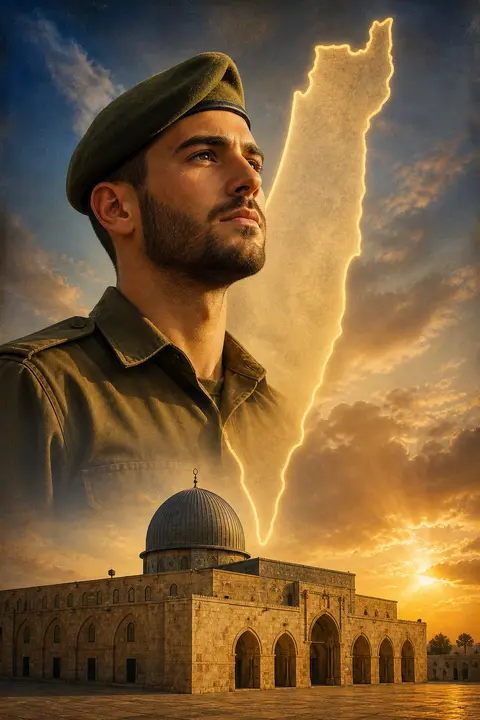
Begin with the army, because here the teaching is explicit. Rabbi Zvi Yehuda Kook, the son and successor whose school of thought became the engine of the settlement movement, taught that the holiness of the state extends to the instruments of its power. In his words, everything connected to the army, "its various types of weapons ... is all holy." He taught further that the work of the state carries the sanctity of the Temple service itself.
Readers of this publication's first series will recognize how large a reversal that is. Jewish tradition treats war as a tragedy that is sometimes necessary. It surrounded war with laws, and it mourned war even in victory. The warrior was never the tradition's ideal, and great rabbis of the nineteenth century taught that glorifying the sword is one of the worst corruptions a civilization can fall into. Secular Zionism, as that series documented, imported Europe's love of the military and made the soldier its icon. The religious Zionist doctrine of the redemption went a step further. It took the borrowed militarism and pronounced it sacred. Within the movement's schools, the uniform became a holy garment and military service became a religious act in itself. An ideology the rabbis had called foreign was now described in the language of the Temple.
The land turned into prophecy
The second consequence concerns the land, and it explains a political pattern the whole world has watched for decades without understanding where it comes from.
In the doctrine, conquered territory is not a political outcome; it is prophecy in progress. Leading religious Zionist rabbis have taught that the difference between the Holy Land of Jewish law and the territory of the State of Israel has essentially disappeared, so that the state's map and the Torah's geography become one holy object. Once that is believed, building settlements is a religious act, and giving back territory is no longer a political compromise but a rebellion against the redemption itself.
This is why territorial compromise produces, in this community, a reaction unlike ordinary political disappointment. When the state withdrew its settlements from Gaza in 2005, the movement experienced it as far more than a defeat. In a belief system where the redemption only moves forward, there was no way to explain the state going backward, and the withdrawal struck the community as a crisis of faith itself. Scholars who study the movement describe its attachment to territory in the same terms as the old European land-worship, the blood-and-soil mysticism this publication's first series traced to its sources. Here too, the doctrine took the foreign import and made it holy.
The mountain
The third consequence is one that readers of this publication have already seen with their own eyes: the ascents of the Temple Mount, led in our own day by a cabinet minister, celebrated as Jews "feeling like the owners of the place."
Recall what Jewish law says, because the earlier article on that episode laid it out. The tradition holds that every Jew today carries an impurity that cannot currently be removed, that the sanctified area may not be entered, and that the fence around the mountain is not a concession to politics but God's own decree. The State of Israel's Chief Rabbinate maintains that ruling, on a sign at the entrance. For centuries, standing below the Mount was the observance.
Now run the religious Zionist doctrine against that. If the redemption is underway and the state is its instrument, then waiting at the bottom of the mountain begins to look not like obedience but like a failure of faith, a refusal to walk through a door God has opened. To the movement's younger generation, the ancient boundary starts to look like an obstacle to the redemption instead of God's own instruction. And so the school that declares the state holy produces crowds that override the ruling of the state's own rabbinate, at Judaism's holiest site, in the name of Judaism. Nothing in this series shows more clearly which authority really rules when the two halves of the graft come into conflict.
The pattern
Put the three examples side by side and the pattern is hard to miss. The first series of this publication documented the objects of devotion that secular Zionism assembled from the Europe of its birth: the sanctified nation, the mystical soil, the honored sword. The founders held those devotions without God, and said so. The religious Zionist doctrine described in the last article dismantled none of them. Instead it declared each one holy, using and corrupting the language of the Torah: the nation became the redemption, the soil became prophecy, and the sword became an instrument of Heaven. The authorities quoted in this series' second article warned, at the beginning, that religious nationalism was the same idolatrous import with the Name of Heaven attached.
A century later, their warning reads less like an argument and more like a plain description of what has happened.
The people on the hilltops
One thing must be said again, and this series will keep saying it. The young families on the settlement hilltops, the soldiers who understand their service as a religious calling, the students climbing the Mount with racing hearts: these are not cynics, and they are not pretending. Most of them are the third or fourth generation raised entirely inside the religious Zionist doctrine, educated in its schools, and they believe they are serving God with everything they have. That is exactly the tragedy this series has been describing since its first article. When sincerity this deep is attached to a teaching this mistaken, the consequences are not small, and they arrive carrying the name of God. The world has watched them accumulate for fifty years under the impression that it is watching Judaism.
The series concludes next with the question that has stood behind every installment: who actually speaks for a tradition, and how an honest observer, standing outside it, can tell.
The Law of the Land Is the Law