The Land They Never Left
Fifth in the series "The Two Thousand Year Argument," on what the Jewish people did with exile. Earlier installments are here: Part 1 | Part 2 | Part 3 | Part 4
In the standard telling of Jewish history, the Jews leave the Land of Israel when Rome destroys the Temple, and they come back in 1948, with the founding of the State of Israel. The eighteen centuries in between are kind of a blank — a long absence, ended at last by a modern state.
But that's a total falsehood. Jews lived in the land the whole time. Never in large numbers, and usually in real poverty, but their presence was never broken. And once you look at who went, and at what they did when they got there, the whole picture comes out different from the one most of us absorbed.
Who kept going
Consider a few of the people who made the trip.
In 1267 the great Spanish scholar known as the Ramban (Nachmanides) arrived in Jerusalem, an old man by then. He found the Jewish community there nearly destroyed — a handful of families, no proper synagogue. He organized one, wrote about what he had seen, and spent his last years in the land. The commentary on the Torah that he finished there can be found in every yeshiva library today.
In the 1500s, refugees from the Spanish expulsion settled in Tzfat, a small town in the northern part of Israel. Rabbi Yosef Karo compiled the code of Jewish law there that still governs practice everywhere, and a circle of mystics rose up around the Arizal, whose teachings reshaped Jewish spiritual life. A poem written in Tzfat in those years to welcome the Sabbath is sung in synagogues around the world every Friday night.
In 1777 a large group of chassidim moved to the land under the leadership of Rabbi Menachem Mendel of Vitebsk. A generation later, students of the Vilna Gaon made the same journey and settled in Tzfat and Jerusalem. Both groups were poor. Both were sustained by funds collected from communities back in Europe, a charity network that ran for centuries so that Jews in the Holy Land could keep learning and praying there.
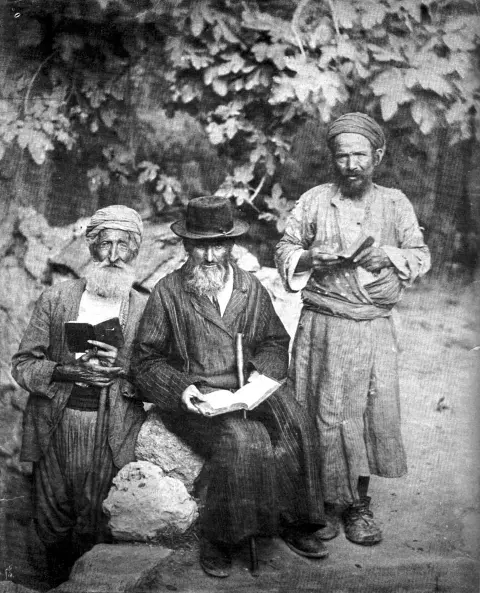
Those communities — which were there long before Zionism existed — are usually called the Old Yishuv.
What they went for
What did all these people actually do there?
They built synagogues and study halls. They prayed at the graves of the prophets and the sages. They wrote books. They arranged to be buried in the land, which a great many Jews considered worth crossing an ocean for. They wrote to relatives asking for support, and the support came.
In eighteen hundred years, not one of these groups organized a government, raised a militia, petitioned an empire for sovereignty, drew borders, or made any political claim on the land at all.
And it certainly wasn't due to timidity. The Ramban had publicly debated the church in front of a king. The Vilna Gaon's students crossed Europe and the Mediterranean on faith and donations. These were not people who lacked nerve.
So why didn't they? Because that wasn't the assignment. The land is holy, and a Jew who lives there has opportunities available to him nowhere else. That is why they went there and lived there, and for no other reason. They understood that the exile, as the earlier articles in this series described, is God's decree, and the same tradition that taught them to yearn for the land taught them that the exile ends when God ends it. Moving to Jerusalem in order to learn and pray and be buried there is one thing. Ending the exile by political force is another thing entirely, and they understood the difference.
What changed in the 1890s
Which raises a question worth putting to anyone who says that Zionism is simply the natural expression of Jewish love for the land.
These Jews loved the land enough to sail there in wooden ships, to arrive destitute, to live on charity from Europe, to bury their children in its soil. For eighteen centuries. And in all that time, nobody founded a movement to take control of it.
Then, in the 1890s, in Europe, a movement appeared that did exactly that. What changed?
Not the love, which had been constant. Not the prayers, which hadn't changed a word. What changed is that European nationalism arrived, and a group of Jews who had already left the religion behind picked it up and applied it to the Jewish people. The idea came from outside. And the strongest evidence for that is those eighteen hundred years, in which people who cherished the land more than any Zionist ever did never once thought of doing what Zionism did.
The community that was already there
There's another part of this story rarely gets told, and it's important.
When the Zionist movement began sending settlers, the Old Yishuv was already there — the religious community that had been there for generations. The two did not get along. The newcomers were largely secular, hostile to the Jewish religion, and openly contemptuous of the old community, whom they regarded as precisely the type of Jew they had come to abolish. The Old Yishuv, for its part, understood quickly what had arrived, and they firmly opposed it.
Zionists often claim that anti-Zionism is a luxury of Jews who don't live in Israel. But the opposition of the Old Yishuv did not come from far away. These were the Jews who did live there. They had been there for generations. They were not opposed to being in the land — they were in the land. What they opposed was what the new arrivals wanted to build on it.
Their descendants are still in Jerusalem, in the same neighborhoods, keeping the same practices, holding the same position. They are the community that the cameras occasionally film as a curiosity, but they have been in that land considerably longer than the state has existed.
So the distinction comes to this. Love of the Land of Israel is Jewish, and ancient, and deep. It runs through the prayers, the law, and the whole history of the people, and anyone who claims otherwise simply hasn't learned the facts.
Political nationalism applied to that land is European, and modern, and arrived in the 1890s. The two are not the same thing, and those eighteen centuries are likely the best proof available. Jews who loved the land went and lived in it and never founded a state. When a movement finally did, it was led by men who had left the religion and said so in print.
This article has given the short answer to why the Jews throughout those eighteen centuries never founded a state: it was not theirs to found. The next one takes up the long answer — what Judaism actually teaches about the Jewish exile, why it holds that only God brings it to an end, and why a people prayed for return every single day without ever concluding that they should go take it.
The Law of the Land Is the Law