Why They Waited
Sixth in the series "The Two Thousand Year Argument," on what the Jewish people did with exile. Earlier installments are here: Part 1 | Part 2 | Part 3 | Part 4 | Part 5
The previous article ended with a puzzle that deserves a real answer.
For eighteen centuries, Jews prayed for the return to Zion three times a day, every day, in every country they lived in. They meant it. Some of them crossed oceans to live in the land, arriving with nothing and living on charity so they could pray and study there. And in all that time, not one of those communities ever organized a movement to take the land and govern it.
To a modern reader that combination is close to incomprehensible. We assume that wanting something and organizing to get it are the same impulse, so a people who wanted Jerusalem that badly for that long should have been forming committees by the fourth century. Something else was clearly going on.
What was going on is a piece of theology, and it is not complicated. It just has to be stated plainly, because almost nobody outside the tradition has ever heard it.
The exile was a sentence, not an accident
Start with how the tradition understands what happened in the year 70, and in 586 BCE before it.
In the Jewish reading, the loss of the land was not a military misfortune that happened to a small nation caught between empires. It was the carrying out of a warning that Scripture had issued in advance and in detail. The Torah states the arrangement directly: the land is given on conditions, it does not tolerate certain kinds of conduct, and a people who break the terms will be removed from it. The prophets repeated the warning for centuries, and when the catastrophe finally came, the tradition did not treat it as a crime committed by Babylon or Rome. It treated it as a verdict, carried out by God, using empires as the instrument.
Jews have said as much in their own prayers ever since, on every festival, in five Hebrew words that a great many of them could recite in their sleep. They translate to: "Because of our sins we were exiled from our land."
Notice what that sentence does. It puts the cause of the exile inside the Jewish people rather than outside them, and it puts the exile itself in God's hands rather than Rome's. Everything else follows from those two moves.
If God sent it, God ends it
A sentence imposed by a judge is not lifted by the prisoner. If the exile came from God as a consequence, then its end belongs to God as well, and the Jewish task in the meantime is not to engineer an escape but to live correctly inside it until He brings it to a close.
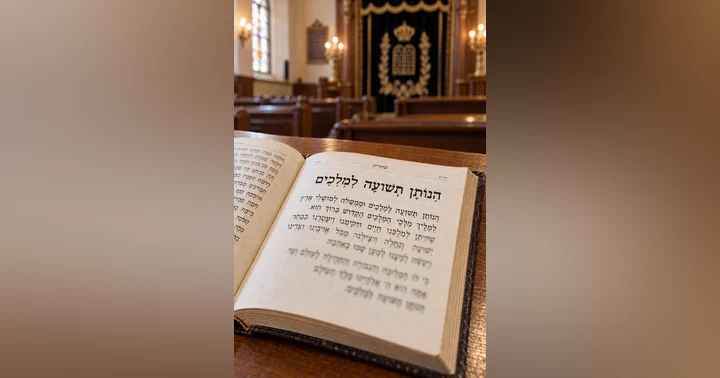
That is exactly what the prayers ask for. As an earlier article in this publication showed, the daily prayer for the ingathering asks God to sound the great horn, to raise the banner, to gather the dispersed from the corners of the earth. It asks Him to restore the courts, to rebuild Jerusalem, to return His presence there, to bring the descendant of David. Every verb in that sequence belongs to God. There is no clause in which the Jewish people are instructed to take the land back themselves, and there never was one.
So the daily prayer and the absence of a political movement are not in tension at all. They are the same position, stated twice. A people asking God for something is not a people planning to seize it.
The tradition also carries an explicit teaching, recorded in the Talmud and repeated across the centuries, that the Jewish people are not to force the end of the exile or to take the land by force of arms. There are volumes of rabbinic discussion about the precise scope of that teaching, but the point that matters here is simply that the teaching exists, that it is ancient, and that it is the standing background of the eighteen centuries described in the last article. Jews who longed for the land and declined to conquer it were not being timid. They were following an instruction.
Learned the hard way
The tradition also holds a second kind of caution, and this one was learned at a terrible price.
More than once over the centuries, a wave of messianic excitement swept through the Jewish world. A figure appeared, or an event was read as a sign, and communities became convinced that the redemption had arrived. People sold their homes. They prepared to leave. And each time, the wave broke, and the cost was heavy: families ruined, communities thrown into disarray, and years of hardship before ordinary life could be put back together.
The sages drew a firm conclusion from those episodes. Announcing that the redemption has begun is not an act of faith. It is the oldest trap in Jewish history, and the tradition built fences around it — warnings against calculating the end, against reading current events as prophecy, against treating political developments as the machinery of redemption.
Anyone who has followed this publication's other series will recognize why that matters. A movement arose in the nineteenth century that did precisely what the fences were built to prevent, and it is still doing it.
Waiting was not sitting still
One misunderstanding has to be cleared away, because a Western reader will arrive at it naturally.
Waiting, in this tradition, does not mean passivity. It certainly does not mean fatalism, and it never meant that Jews should do nothing until Heaven acted.
The previous articles in this series described what the waiting actually looked like. Academies that ran for centuries. Legal systems maintained across three continents. Charity networks, schools for every child, courts, communities rebuilt after every expulsion. Thousands of Jews moving to the Holy Land over the centuries to pray and study and be buried there. Codes of law compiled, commentaries written, questions answered across oceans.
That is not a people sitting on its hands. It is a people doing the work it had been given, in the place it found itself, for as long as it took. The waiting was an assignment, not a pause between assignments.
And the tradition understood the exile as having a purpose beyond punishment. Scattered among the nations, Jews were to keep the Torah in full view of everyone, and the way they lived was itself a form of testimony. There is a reason the sources speak so much about honesty in business, about conduct that brings honor rather than shame to God's name. A people with no army and no country had exactly one instrument available, and it was their own behavior.
What this explains
Put the pieces together and the puzzle from the last article dissolves.
Jews prayed daily for the return because they wanted it more than they wanted almost anything. They never organized to seize it because the same tradition that taught them to want it taught them Whose act the return would be, and warned them specifically against forcing it themselves. Both halves came from the same source, and for eighteen centuries nobody found them contradictory.
Then a movement appeared that kept the longing and discarded the instructions, and told the world it was fulfilling an ancient Jewish hope.
How that story came to replace the real one, and who found the replacement useful, is the subject of the next article.

The Jewel and the Donkey