The Poet on the Fifty-Shekel Note
Seventh in a series on Zionism, Judaism, and why the difference matters. Earlier installments are collected here: Part 1 | Part 2 | Part 3 | Part 4 | Part 5 | Part 6
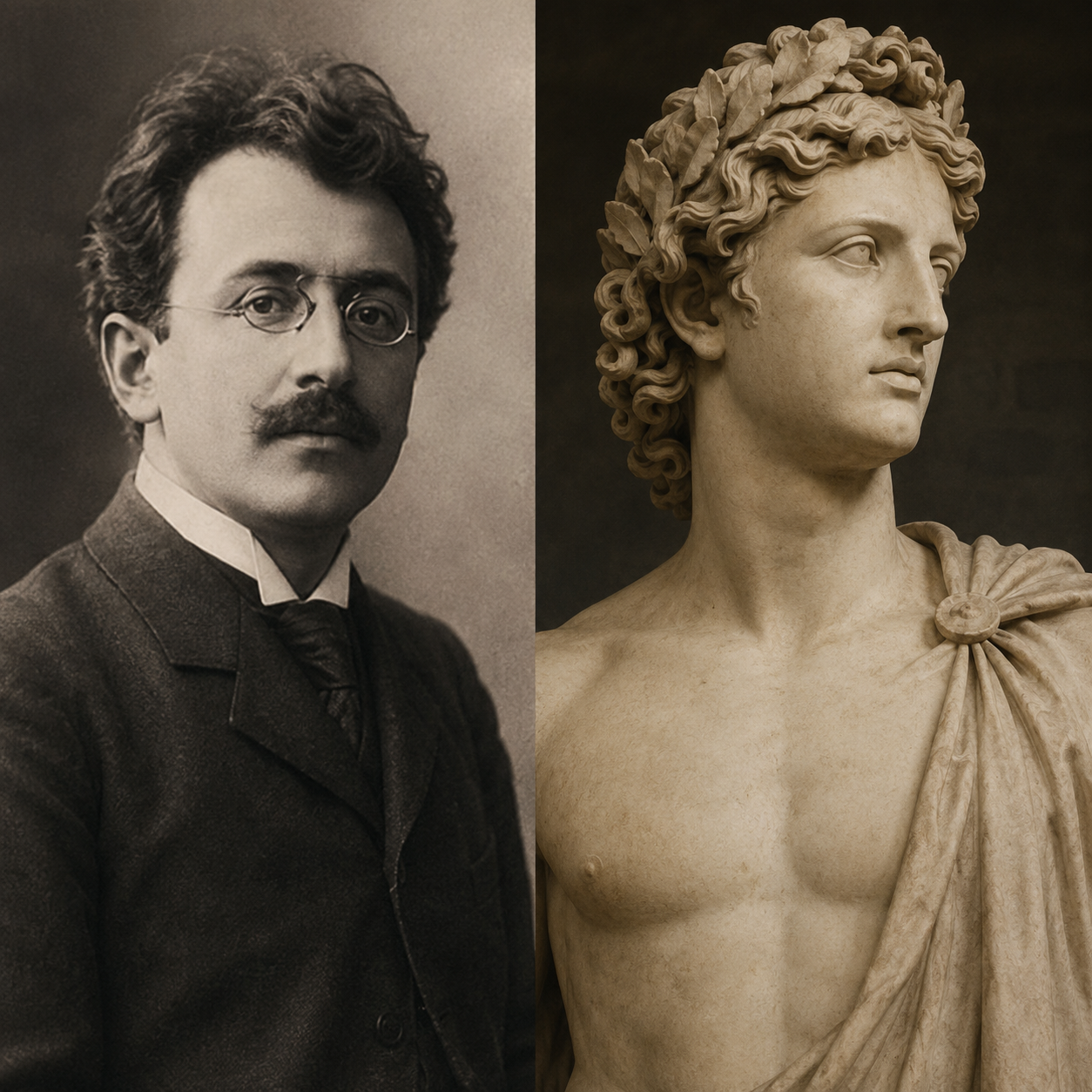
A country's money is a small museum of its heroes. Israel's fifty-shekel note carries the face of Shaul Tchernichovsky, one of the most celebrated poets of the Hebrew revival, honored by the state as a founding voice of its culture. Schoolchildren learn his verses. Streets bear his name.
In 1899, Tchernichovsky wrote the poem that made him famous. It is called "Facing a Statue of Apollo," and it is exactly what the title says: a Hebrew ode addressed to the Greek god. The poem is not a curiosity or a youthful indiscretion. It is a manifesto, and what it declares tells a reader more about the movement this series has been describing than a shelf of history books.
What the poem says
The speaker of the poem stands before an image of Apollo, god of light, beauty, and vigor, and introduces himself: he is the Jew, the god's ancient enemy. He has crossed a great distance to arrive here, he says, and he has come to repent. He announces himself as the first of his people to return, to bow before the statue, to honor life, beauty, and strength, and to seek pardon for what his ancestors did.
What did they do? In the poem's telling, the Jews once knew the true god, the wild god of nature who stormed the land of Canaan in conquest. Then they captured him. In the poem's most notorious image, the conquering deity was tied down when the Jews, as the verse puts it, "bound him with the straps of the tefillin." Tefillin are the small leather boxes and straps that Jewish men wear in daily prayer, among the most important objects of Jewish devotion. In Tchernichovsky's telling they are ropes around a captive: the Torah, with its laws and its prayers and its endless demands of the spirit, imprisoned the god of vitality, and religious Judaism has been guarding the cell ever since. The poet has now escaped the prison. He returns from the God of Israel to the god of the Greeks.
There is no way to soften what this is. A founding poet of the Hebrew revival, honored today on the state's currency, composed a formal renunciation of Judaism addressed to a pagan idol, and it became one of the anthems of his generation.
Why Apollo, of all gods
Tchernichovsky was not unique in this. He was, perhaps, just the most honest man in the movement, saying with a poet's clarity what the ideology implied.
Recall the project the previous articles have traced. The founders wanted to reverse the traditional Jewish personality. The ideal Jew of the tradition was the scholar, a creature of the book and the spirit, trained to master instinct, to analyze every act, to prize the soul's fitness over the body's appetites. The new Hebrew was to be his opposite: earthy, physical, instinctive, at home in his muscles and his soil. Nietzsche supplied the philosophy for that reversal, as article three described. But a reversal of religious character eventually wants a religion of its own, and there was one ready on the shelf. Paganism is precisely the worship of vitality: the sacralizing of earth, body, strength, and appetite. It is the religious form of everything the Torah personality restrains.
Serious observers said as much at the time and have said so since. The historian Amos Elon, no religious partisan, wrote that the reverence Labor Zionism showed toward land and nature was "far more evocative of paganism than of Judaism." Other scholars of the movement have described a longing for the pagan and the gentile stirring openly inside Zionist culture. The kibbutz mystique of article four, the soil that had become the holy of holies, the mystical fusion of nation and land from article two: all of it belongs to this family. The era's fashionable nature-mysticism, which taught that a vital force pulses through the natural world and that religion had smothered mankind's healthy instincts, gave the whole tendency a respectable philosophical dress. Strip the dress off and the body underneath is very old. It is the nature-worship the prophets of Israel spent their lives fighting.
Rewriting the past to match
Some went further than adopting the pagan mood. They rewrote Jewish history to claim it had been pagan all along.
Micha Yosef Berdyczewski, the self-declared Nietzschean of article three, taught that the original religion of the Hebrews was a joyous cult of blood, incense, and dancing on the hilltops, and that the disaster of Jewish history was the arrival of the Torah, which buried a living people under a book. His writings imagine the Jews pleading to be released from their own scriptures, and he demanded the restoration of what was lost: "Give us back our trees and our fields!"
Moses Hess, the socialist often counted as the first modern Zionist, had earlier argued in a similar spirit that Judaism's authentic core was sacrificial and earthy rather than legal and spiritual. In these tellings the rabbis, the study halls, the entire civilization of Jewish learning, amount to one long mistake. The real Judaism was Canaan. The Torah interrupted it.
Traditional Judaism has a name for this material, and the name is not radical scholarship. Scripture spends whole books recording Israel's struggle against exactly these cults, the altars on the hills and the worship of nature and appetite, and records the prophets denouncing them as the negation of everything the covenant stands for. The Zionist writers knew this perfectly well. That was the attraction. To locate authentic Jewishness in the hilltop altars is to declare, in the most complete way possible, that the God of Israel was the foreign element in Jewish history and the idols were the natives.
The museum on the money
Which brings us back to Israel's fifty-shekel note. States choose their heroes deliberately. When Israel placed Tchernichovsky's face on its currency, it was not endorsing every stanza he wrote, but it was declaring him a father of the national culture, and it was right. He is. The culture the founders built really does descend from the sensibility his poem announced: the exaltation of land, body, vigor, and nation, wearing biblical vocabulary the way the poem wears Hebrew meter, with God summarily retired.
The practical conclusion is the one every road in this series reaches. A state whose formative poets sang to Apollo, whose philosophers located true Jewishness in the hilltop cults, and whose pioneers called the soil their holy of holies is many things. But it is not Judaism.
The religion of Israel's founders was built in conscious rebellion against the religion of Judaism, and its own poets said so in verse, beautifully, over a century ago. Just read it for yourself.
The series concludes next with the question underneath every article so far: who is a Jew? Two answers, the covenant's and the state's, and why the difference decides everything else.
A Prayer for the Government